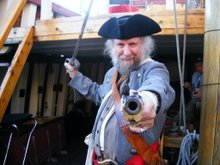
Actually, it was Talk Like a Pirate Weekend on the Santa Maria.
Some aspects of it were grueling. This was the ship's busiest weekend and several of us were doing presentation for the tours. That was a lot of presentations. Also, so many people were going through that the groups were larger than normal which made it hard to get everyone around. The price of success.
We had fewer pirates than during the May event but not by too many. The pirates who were there were enthusiastic. I've been to a lot of different events and this was the only one I can remember where most people waited until the 5:00 closing to start packing to leave. Usually people start packing around 3:00. This meant that we finally left the ship after 6:30.
Both days had a battle between the boats and the ship. On Saturday we used the Black Sheep and the canoe. On Sunday we had a few more people and added one person in a small boat.
There was an arts festival going on on the other side of the river so several of us spent some time checking it out and publicizing the event.
One woman spent much of the weekend playing "the governor's daughter" being help for ransom (she's the smiling red-head holding the flag). She went through the arts festival with her wrists shackled and, both days after the battle she was captured and hustled into the hold where she was "locked up". A couple of kids took this very seriously. One girl refused to leave the ship until she saw the prisoner rescued. She even stole the keys to her shackles. A boy at the arts festival on Saturday made his parents bring him to the ship Sunday so that he could pay the ransom (I think he offered a penny).
Monday, September 20, 2010
Friday, September 17, 2010
International Talk Like a Pirate Day
Talk Like a Pirate Day (ITLAPD) is 15 years old this year (technically that makes this one the 16th). For something that started as kind of a joke between a couple of guys playing racquetball, this has really taken off. It helps that three of the decade's most successful movies featured pirates but I think that they tapped into a societal need to play at being a pirate. Even before the movies several Renaissance festivals included pirates and some had become full-blown pirate festivals.
Of course, what really got the ball rolling was the Dave Barry column. At the time, Barry was the country's leading comedy columnist. There was even a sit-com based on his books. Barry's column got the word out to the world. I remember reading it in 2003. In 2004 I wore a pirate T-shirt on ITLAPD. I also wore a pirate T-shirt in 2007 and people stopped me on the street (of Charleston, SC) to tell me that it was Talk Like a Pirate Day (Why do you think I'm wearing the T-shirt?).
We are having a pirate weekend on the Santa Maria. The event got mentioned in the local papers because of ITLAPD. Lots of kids show up in pirate hats or wearing an eye patch (usually pushed up to the forehead).
The weather forecast for the weekend is perfect so it should be a good event.
Of course, what really got the ball rolling was the Dave Barry column. At the time, Barry was the country's leading comedy columnist. There was even a sit-com based on his books. Barry's column got the word out to the world. I remember reading it in 2003. In 2004 I wore a pirate T-shirt on ITLAPD. I also wore a pirate T-shirt in 2007 and people stopped me on the street (of Charleston, SC) to tell me that it was Talk Like a Pirate Day (Why do you think I'm wearing the T-shirt?).
We are having a pirate weekend on the Santa Maria. The event got mentioned in the local papers because of ITLAPD. Lots of kids show up in pirate hats or wearing an eye patch (usually pushed up to the forehead).
The weather forecast for the weekend is perfect so it should be a good event.
Monday, August 16, 2010
Pirates of Paynetown
This has been one of my favorite pirate events but I have to admit that this year was a bit off for several reasons:
That said, it was still an enjoyable event.
Not a lot happened Friday. It was too hot. Also, there was not much breeze for sailing. Last year we had a dusk cannon firing and an improvised ship battle on Friday. This year we had cannon firing both Friday and Saturday but no ship battle.
On a personal note, my wife injured her knee Friday and could not walk without crutches.
I didn't get much sleep Friday night. Some musicians camped next to us played past 3 am. They ran out of period music around 1:30 and degenerated into "do you know this?" followed by a snatch of music. At five, my wife needed help going to the bathroom. At six the wind picked up, threatening rain so I had to quickly get things under cover.
The wind did cool things down. There was a slight drizzle a while later which blew over quickly.
The Saturday battle was cut short by an actual rainstorm. We go off a couple of shots before the guns became too wet to fire. The rain didn't last long.
Sunday's battle was far better. The Priddy Princess joined in as a British ship so we had a battle between it and the other boats. This was the second time I got to use the full-sized swivel gun on the Black Sheep. It was quite loud, matching the bigger pieces in the camp and outclassing the Princess's smaller swivel.
As always, the event had a variety of historic boats with people often going out sailing or rowing. The breeze was light so no one sailed very far from camp but it was common to see one or two boats on the lake.
- The main organizer, Nate, has been overwhelmed by his first child and by modifying a historic building so a lot less preparation went into this year's event. It is running on "auto-pirate".
- The weather was not kind to us. Friday was very hot - in the mid-90s. Saturday was a bit cooler. Sunday started cooler but got hot again in the afternoon.
- The event seems less like a pirate event and more like a generic one. In previous years there were a lot more displays and jolly roger flags visible.
- Attendance was down. One entire unit came down with the flu.
That said, it was still an enjoyable event.
Not a lot happened Friday. It was too hot. Also, there was not much breeze for sailing. Last year we had a dusk cannon firing and an improvised ship battle on Friday. This year we had cannon firing both Friday and Saturday but no ship battle.
On a personal note, my wife injured her knee Friday and could not walk without crutches.
I didn't get much sleep Friday night. Some musicians camped next to us played past 3 am. They ran out of period music around 1:30 and degenerated into "do you know this?" followed by a snatch of music. At five, my wife needed help going to the bathroom. At six the wind picked up, threatening rain so I had to quickly get things under cover.
The wind did cool things down. There was a slight drizzle a while later which blew over quickly.
The Saturday battle was cut short by an actual rainstorm. We go off a couple of shots before the guns became too wet to fire. The rain didn't last long.
Sunday's battle was far better. The Priddy Princess joined in as a British ship so we had a battle between it and the other boats. This was the second time I got to use the full-sized swivel gun on the Black Sheep. It was quite loud, matching the bigger pieces in the camp and outclassing the Princess's smaller swivel.
As always, the event had a variety of historic boats with people often going out sailing or rowing. The breeze was light so no one sailed very far from camp but it was common to see one or two boats on the lake.
Wednesday, August 11, 2010
Flint and Silver
I wrote about John Drake's Treasure Island prequels after reading the second novel in the series, Pieces of Eight. That one was on the bookshelves when I was in England in May so that's what I read first. It was good enough for me to get the first book in the series, Flint and Silver.
First, I want to stress that these are not children's books. They are aimed at adults who enjoyed Treasure Island as a child. The object of the series is to tell the back story of who Captain Flint was and how his treasure came to be buried on a desert island. It also tells how Silver lost his leg and gained his wife and parrot.
Flint and Silver is the story of how the two men became pirates, joined forces, then split apart. It is well-written in period-sounding, nautical language that any pirate will enjoy.
Of the two novels, Pieces of Eight is the better. There are a few oddities about how Flint and Silver is constructed. Drake is anxious to get his characters together so the chapters are not in chronological order. When the heroine, Selene, is introduced, Flint and Silver have already been sailing together for some time but the chapter where they actually meet come later. Be sure to pay attention to the dates at the top of the chapters and it all makes sense.
Another quibble - the book glosses over the time that the two spent working together.
Regardless, it is still a fun read.
First, I want to stress that these are not children's books. They are aimed at adults who enjoyed Treasure Island as a child. The object of the series is to tell the back story of who Captain Flint was and how his treasure came to be buried on a desert island. It also tells how Silver lost his leg and gained his wife and parrot.
Flint and Silver is the story of how the two men became pirates, joined forces, then split apart. It is well-written in period-sounding, nautical language that any pirate will enjoy.
Of the two novels, Pieces of Eight is the better. There are a few oddities about how Flint and Silver is constructed. Drake is anxious to get his characters together so the chapters are not in chronological order. When the heroine, Selene, is introduced, Flint and Silver have already been sailing together for some time but the chapter where they actually meet come later. Be sure to pay attention to the dates at the top of the chapters and it all makes sense.
Another quibble - the book glosses over the time that the two spent working together.
Regardless, it is still a fun read.
Flint and Silver
I wrote about John Drake's Treasure Island prequels after reading the second novel in the series, Pieces of Eight. That one was on the bookshelves when I was in England in May so that's what I read first. It was good enough for me to get the first book in the series, Flint and Silver.
First, I want to stress that these are not children's books. They are aimed at adults who enjoyed Treasure Island as a child. The object of the series is to tell the back story of who Captain Flint was and how his treasure came to be buried on a desert island. It also tells how Silver lost his leg and gained his wife and parrot.
Flint and Silver is the story of how the two men became pirates, joined forces, then split apart. It is well-written in period-sounding, nautical language that any pirate will enjoy.
Of the two novels, Pieces of Eight is the better. There are a few oddities about how Flint and Silver is constructed. Drake is anxious to get his characters together so the chapters are not in chronological order. When the heroine, Selene, is introduced, Flint and Silver have already been sailing together for some time but the chapter where they actually meet come later. Be sure to pay attention to the dates at the top of the chapters and it all makes sense.
Another quibble - the book glosses over the time that the two spent working together.
Regardless, it is still a fun read.
First, I want to stress that these are not children's books. They are aimed at adults who enjoyed Treasure Island as a child. The object of the series is to tell the back story of who Captain Flint was and how his treasure came to be buried on a desert island. It also tells how Silver lost his leg and gained his wife and parrot.
Flint and Silver is the story of how the two men became pirates, joined forces, then split apart. It is well-written in period-sounding, nautical language that any pirate will enjoy.
Of the two novels, Pieces of Eight is the better. There are a few oddities about how Flint and Silver is constructed. Drake is anxious to get his characters together so the chapters are not in chronological order. When the heroine, Selene, is introduced, Flint and Silver have already been sailing together for some time but the chapter where they actually meet come later. Be sure to pay attention to the dates at the top of the chapters and it all makes sense.
Another quibble - the book glosses over the time that the two spent working together.
Regardless, it is still a fun read.
Wednesday, August 4, 2010
Monday, August 2, 2010
Navigation
Yesterday the Santa Maria celebrated the 518th anniversary of Columbus leaving port (the actual date is tomorrow but special events work better on weekends). Since the event is called "Navigation Day" I brought some of my personal collection of navigational tools and gave some talks on period navigation. At the same time, I've been reading Flint and Silver. A major plot point of this (and of Treasure Island) is that Long John Silver and his crew of pirates do not know how to navigate. This was also a plot point in Captain Blood. This got me thinking about period navigation. What was it that made navigation so difficult?
Any time a ship was out of sight of land it used "dead reckoning." This boils down to keeping careful track of what direction you are going and how fast you are traveling and figuring your position from that. The basic tools were the compass, the sandglass, the traverse board, and the log line (with its own sand glass).
Every half hour the helmsman would turn the glass and put a pin in the traverse board. The traverse board looked like the face of a compass and had eight concentric rings of holes. Each ring corresponded to a turn of the glass and each hole corresponded to a point on the compass. There were 32 points.
At the same time, the ship's speed would be taken with a log line. This was a spool of cord with a piece of wood on one end. The piece of wood would be thrown overboard and it would pull the cord out after it. The cord had knots at regular intervals. A sand glass would be turned. When the sand ran out you would see how many knots had unspooled and mark that on a scale at the bottom of the traverse board.
At the end of a shift, the results would be written on a slate and given to the navigator. He would use this to plot how far the ship had come and which direction and mark it on his charts.
This is where things get complicated. Each chart might have its own scale. Trying to match positions from one chart to another could be difficult.
Any changes in course would affect the accuracy. If the course was changed five minutes into a shift it would still show the same as if it had been changed 25 minutes into the shift.
The effects of currents had to guessed. The only way of measuring a current was to drop a sounding lead into the water and see if the line bowed out some.
The majority of people at that time could add and subtract but not multiply or divide. Some multiplication and division was needed.
There were other tricks that came from instruction or practice. If the bottom was close enough for a sounding, you would put some fresh tallow into a depression in bottom of the sounding lead. This would bring up a little of the bottom. Really detained charts of known waters might include information about the bottom - sandy, gravel, silt, etc. Even if you were out of sight of land, silt meant that a river mouth was near.
You could check your latitude with various instruments that measured the angle of the sun or North Star. There was no way of figuring longitude at sea.
Sailors left all of this to the navigator. Without charts and the logs, there was no way for them to tell anything but the rough direction, anyway. All that mattered to them was not getting lost.
Any time a ship was out of sight of land it used "dead reckoning." This boils down to keeping careful track of what direction you are going and how fast you are traveling and figuring your position from that. The basic tools were the compass, the sandglass, the traverse board, and the log line (with its own sand glass).
Every half hour the helmsman would turn the glass and put a pin in the traverse board. The traverse board looked like the face of a compass and had eight concentric rings of holes. Each ring corresponded to a turn of the glass and each hole corresponded to a point on the compass. There were 32 points.
At the same time, the ship's speed would be taken with a log line. This was a spool of cord with a piece of wood on one end. The piece of wood would be thrown overboard and it would pull the cord out after it. The cord had knots at regular intervals. A sand glass would be turned. When the sand ran out you would see how many knots had unspooled and mark that on a scale at the bottom of the traverse board.
At the end of a shift, the results would be written on a slate and given to the navigator. He would use this to plot how far the ship had come and which direction and mark it on his charts.
This is where things get complicated. Each chart might have its own scale. Trying to match positions from one chart to another could be difficult.
Any changes in course would affect the accuracy. If the course was changed five minutes into a shift it would still show the same as if it had been changed 25 minutes into the shift.
The effects of currents had to guessed. The only way of measuring a current was to drop a sounding lead into the water and see if the line bowed out some.
The majority of people at that time could add and subtract but not multiply or divide. Some multiplication and division was needed.
There were other tricks that came from instruction or practice. If the bottom was close enough for a sounding, you would put some fresh tallow into a depression in bottom of the sounding lead. This would bring up a little of the bottom. Really detained charts of known waters might include information about the bottom - sandy, gravel, silt, etc. Even if you were out of sight of land, silt meant that a river mouth was near.
You could check your latitude with various instruments that measured the angle of the sun or North Star. There was no way of figuring longitude at sea.
Sailors left all of this to the navigator. Without charts and the logs, there was no way for them to tell anything but the rough direction, anyway. All that mattered to them was not getting lost.
Subscribe to:
Posts (Atom)