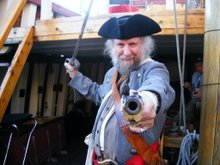
Just a day and a half before we leave for New Orleans. I'm looking forward to this. Not that I expect much accuracy. But, a chance to run around the French Quarter dressed like a pirate doesn't need much excuse.
Just to get in the mood on the way down I have my N800 Internet Tablet loaded with a couple of e-books (Treasure Island and a Captain Blood sequel), a Pirate podcast from Talk Like A Pirate Day, and the silly Pirate Movie which I've never actually seen. I might load a copy of Treasure Island, too - either the 1950s one or the Muppet one.
Wednesday, April 16, 2008

Tuesday, April 8, 2008
More on Muskets
Here's a thought I just had - the original pirates of the Caribbean were largely recruited from the Cow Killers. These were hunters who shot wild cows left on the islands by early Spanish colonies. The colonies were abandoned as new sources of gold were found and the cattle released into the wild.
By the 2nd quarter of the 17th century a group of non-Spanish had moved into the islands. They were largely English and French. They shot cattle and dried the meat over a slow fire. The process was known as boucaning. It is the root word for barbecue and buccaneer (boucanier - someone who boucans).
Every now and then the Spanish would try to clear the cow killers off of "their" islands. The main place for displaced cow killers to go was Tortuga.
When the English recruited people to raid the Spanish they got a lot of men who had been cow killers, enough that the French word for the cow killers became synonymous with pirates.
So, we have a significant portion of pirates who used to make their living shooting animals with their muskets. They were good shots, too. Are these men going to toss their muskets into the ocean and switch to blunderbusses? I doubt it.
So the people who insist that pirates had no use for long weapons haven't really thought about where the pirates were recruited from.
By the 2nd quarter of the 17th century a group of non-Spanish had moved into the islands. They were largely English and French. They shot cattle and dried the meat over a slow fire. The process was known as boucaning. It is the root word for barbecue and buccaneer (boucanier - someone who boucans).
Every now and then the Spanish would try to clear the cow killers off of "their" islands. The main place for displaced cow killers to go was Tortuga.
When the English recruited people to raid the Spanish they got a lot of men who had been cow killers, enough that the French word for the cow killers became synonymous with pirates.
So, we have a significant portion of pirates who used to make their living shooting animals with their muskets. They were good shots, too. Are these men going to toss their muskets into the ocean and switch to blunderbusses? I doubt it.
So the people who insist that pirates had no use for long weapons haven't really thought about where the pirates were recruited from.
Friday, April 4, 2008
The Eyepatch Myth (again)
Mythbusters showed their original pirate episode this week. This included the myth that pirates with normal vision wore an eyepatch so that they could go into a dark room without having to wait for their vision to adjust. The Mythbusters proved that this works but didn't comment on whether pirates actually did this.
I've written about this before but I had a slightly new insight. First I will cover the reasons why I think that this is a myth:
A pirate would want both eyes in a fight. Covering one gives you a literal blind spot and affects depth perception. This will get you killed in a fight.
There are few places on a ship where you need to go into a dark place quickly. The hold is one such place but this overlooks how pirates actually operated. Pirates normally forced the crew of a ship to surrender then spent hours or days ransacking a ship. Someone hiding in the hold might have a long wait and would be fairly ineffective. Someone hiding in the hold, waiting to attack pirates individually as they entered would be quickly discovered and put to a painful death. This would also be one fewer person trying to save the ship in the first place. Any fighters hiding in the hold would be expected to emerge and join in the fight before the crew surrendered. This is how Maynard captured Blackbeard.
I have been collecting books on pirates since the 1980s but I never ran across this myth until Mythbusters ran it. I've been looking through books on piracy since then and I only find it in the newer ones. That makes me think that this is not only a myth, it is a recent on. I'm guessing that it was invented after 2000.
The one place I had run across the idea of using an eyepatch to preserve night vision was in a novel - Not Quite Scaramouche by Joel Rosenburg. In this book, three soldiers are accumulating funds for their retirement by robbing thieves. One of them flashes some money in a tavern while wearing an eyepatch. As soon as he leaves he moves the patch to the other eye and leads the inevitable cutthroats following him into a trap. This book was published in 2001 which is exactly right for my theory.
So my guess is that a fan of Rosenburg speculated that lots of people wore eyepatches to preserve night vision historically. From there it is an easy jump to assume that the group of people associated with eyepatches must have worn them for some reason besides the obvious.
----------------
As for eyepatches in general, I have yet to see a contemporary description of a pirate wearing one for any reason. A pirate who lost an eye would be given a lump sum payment and would probably either retire or take a non-combat job. Treasure Island was on the money with Long John Silver becoming a cook after losing a leg.
I might as well mention my theory that image of the pirate with a pegleg is a combination of Long John Silver (on crutches) and Captain Ahab (pegleg but not a pirate).
I've written about this before but I had a slightly new insight. First I will cover the reasons why I think that this is a myth:
A pirate would want both eyes in a fight. Covering one gives you a literal blind spot and affects depth perception. This will get you killed in a fight.
There are few places on a ship where you need to go into a dark place quickly. The hold is one such place but this overlooks how pirates actually operated. Pirates normally forced the crew of a ship to surrender then spent hours or days ransacking a ship. Someone hiding in the hold might have a long wait and would be fairly ineffective. Someone hiding in the hold, waiting to attack pirates individually as they entered would be quickly discovered and put to a painful death. This would also be one fewer person trying to save the ship in the first place. Any fighters hiding in the hold would be expected to emerge and join in the fight before the crew surrendered. This is how Maynard captured Blackbeard.
I have been collecting books on pirates since the 1980s but I never ran across this myth until Mythbusters ran it. I've been looking through books on piracy since then and I only find it in the newer ones. That makes me think that this is not only a myth, it is a recent on. I'm guessing that it was invented after 2000.
The one place I had run across the idea of using an eyepatch to preserve night vision was in a novel - Not Quite Scaramouche by Joel Rosenburg. In this book, three soldiers are accumulating funds for their retirement by robbing thieves. One of them flashes some money in a tavern while wearing an eyepatch. As soon as he leaves he moves the patch to the other eye and leads the inevitable cutthroats following him into a trap. This book was published in 2001 which is exactly right for my theory.
So my guess is that a fan of Rosenburg speculated that lots of people wore eyepatches to preserve night vision historically. From there it is an easy jump to assume that the group of people associated with eyepatches must have worn them for some reason besides the obvious.
----------------
As for eyepatches in general, I have yet to see a contemporary description of a pirate wearing one for any reason. A pirate who lost an eye would be given a lump sum payment and would probably either retire or take a non-combat job. Treasure Island was on the money with Long John Silver becoming a cook after losing a leg.
I might as well mention my theory that image of the pirate with a pegleg is a combination of Long John Silver (on crutches) and Captain Ahab (pegleg but not a pirate).
Sunday, March 30, 2008
Review: Pirate Freedom
Pirate Freedom by Gene Wolfe
There aren't many pirate novels being published these days but this is a good one. Wolfe did a lot of research on pirates, sailing, and geography for this novel.
The plot is fairly straightforward but the set-up is strange. Chris, a boy raised a post-Castro monastery in Cuba goes into the outside world and finds himself in the late 17th century. He becomes a sailor, a captain, a cow killer, and finally a pirate.
The novel is in the form of a confession or memoir written by Chris in the early 20th century where he is a priest looking back at his youth. There is no explanation for the time-travel. It just happens.
If the book has a flaw it is that there are too many coincidences. Nearly everyone that Chris meets returns later. Also, for some reason, all women seem to want him. He has four or five women chasing after him at different points.
The novel is at its best when talking about sailing and actual pirate raids. Without giving a great deal of detail, Wolfe manages to invoke the feeling that he was actually there.
Unlike larger than life characters like Captain Blood, Chris is very human. He makes mistakes and admits them, often judging himself harder than an outsider would.
There aren't many pirate novels being published these days but this is a good one. Wolfe did a lot of research on pirates, sailing, and geography for this novel.
The plot is fairly straightforward but the set-up is strange. Chris, a boy raised a post-Castro monastery in Cuba goes into the outside world and finds himself in the late 17th century. He becomes a sailor, a captain, a cow killer, and finally a pirate.
The novel is in the form of a confession or memoir written by Chris in the early 20th century where he is a priest looking back at his youth. There is no explanation for the time-travel. It just happens.
If the book has a flaw it is that there are too many coincidences. Nearly everyone that Chris meets returns later. Also, for some reason, all women seem to want him. He has four or five women chasing after him at different points.
The novel is at its best when talking about sailing and actual pirate raids. Without giving a great deal of detail, Wolfe manages to invoke the feeling that he was actually there.
Unlike larger than life characters like Captain Blood, Chris is very human. He makes mistakes and admits them, often judging himself harder than an outsider would.
Tuesday, March 11, 2008
Long guns
Many pirate books insist that pirates scorned all firearms except pistols and blunderbusses. This is based on a Hollywood-inspired view of how sea battles work.
In the movies two ships will blast away at each other with cannons. Finally they pull alongside and grapple with the pirates swinging across to their prey which they take and lillage moments before it sinks. There are some problems with this.
First, pirates didn't want to sink other ships if they could help it. It could take days to find and transfer all available valuables from one ship to the other. Yes, if they needed to they would blast away with cannons, but this was a last resort.
It was far better to use small arms against an opposing ship. This phase of the battle would go on before the ships were within grappling distance and could go on for some time.
A pistol is a short-range weapon. A blunderbuss is a short-barreled shotgun. It is best when fired into a crowd at short distances. Neither is useful as a ship-to-ship weapon.
That's where the long guns come in. I am lumping muskets, rifles, and carbines together in this classification. Pirates tended to use whatever they could get a hold of.
Sometimes pirates didn't even attack from a ship. There are accounts of pirates taking a ship from dug-out canoes using long guns.
All of this is justification for my newest toy, a snaphaunse musket.
The "modern" flintlock was invented in France around 1630. There were other variations that were in use before this and continued in use decades later. All of them have a pan which holds priming powder. The powder is kept in the pan with a cover. A spring-loaded cock knocks a flint against a striking plate which ignites the priming powder. The resulting flame goes through the touch hole and ignites the main charge.
The flintlock combines the striking plate (called a frizzon here) and the pan cover.
With the snaphaunce the pan cover is separate from the striking plate (called a battery in these locks). In early snaphaunces the musketeer had to open the pan cover by hand but later an internal level was added to the lock to open the pan.
If this seems complicated, it was. I've counted pieces and the snaphaince has at least twice as many pieces as a flintlock. That made it more expensive which is what eventually did it in. Regardless of this, it was a reliable lock and was used from the late 16th century through to the early 18th century. According to The Rifle Shoppe which is where my lock came from, both the lock and the fan-tailed stock usually associated with earlier pieces were still being exported to the colonies at the end of the 17th century.
This means that pirates must have had some. Like I said, they tended to use whatever they could get a hold of.
Flintlocks are probably over represented at pirate events. This is understandable. They are still cheaper to make and much more common. Many pirate reenactors use later century weapons from a time when most guns were flintlocks.
In the movies two ships will blast away at each other with cannons. Finally they pull alongside and grapple with the pirates swinging across to their prey which they take and lillage moments before it sinks. There are some problems with this.
First, pirates didn't want to sink other ships if they could help it. It could take days to find and transfer all available valuables from one ship to the other. Yes, if they needed to they would blast away with cannons, but this was a last resort.
It was far better to use small arms against an opposing ship. This phase of the battle would go on before the ships were within grappling distance and could go on for some time.
A pistol is a short-range weapon. A blunderbuss is a short-barreled shotgun. It is best when fired into a crowd at short distances. Neither is useful as a ship-to-ship weapon.
That's where the long guns come in. I am lumping muskets, rifles, and carbines together in this classification. Pirates tended to use whatever they could get a hold of.
Sometimes pirates didn't even attack from a ship. There are accounts of pirates taking a ship from dug-out canoes using long guns.
All of this is justification for my newest toy, a snaphaunse musket.
The "modern" flintlock was invented in France around 1630. There were other variations that were in use before this and continued in use decades later. All of them have a pan which holds priming powder. The powder is kept in the pan with a cover. A spring-loaded cock knocks a flint against a striking plate which ignites the priming powder. The resulting flame goes through the touch hole and ignites the main charge.
The flintlock combines the striking plate (called a frizzon here) and the pan cover.
With the snaphaunce the pan cover is separate from the striking plate (called a battery in these locks). In early snaphaunces the musketeer had to open the pan cover by hand but later an internal level was added to the lock to open the pan.
If this seems complicated, it was. I've counted pieces and the snaphaince has at least twice as many pieces as a flintlock. That made it more expensive which is what eventually did it in. Regardless of this, it was a reliable lock and was used from the late 16th century through to the early 18th century. According to The Rifle Shoppe which is where my lock came from, both the lock and the fan-tailed stock usually associated with earlier pieces were still being exported to the colonies at the end of the 17th century.
This means that pirates must have had some. Like I said, they tended to use whatever they could get a hold of.
Flintlocks are probably over represented at pirate events. This is understandable. They are still cheaper to make and much more common. Many pirate reenactors use later century weapons from a time when most guns were flintlocks.
Friday, February 22, 2008
It's hard to be a pirate in the winter
I haven't been posted very often. It's hard to feel piraty when it is snowing outside and the temperature is in the single digits. You think of pirates in the Caribbean where it is always warm. Some pirates did have to put up with northern waters and storms.
The Pilgrims had the worst of some pirates. Shortly after the first Thanksgiving, the ship the Fortune arrived with new colonists and a demand for profit from the investors. They were upset that the Mayflower had been sent back empty. The fact that half the colony was busy dying at the time made no difference to them.
The Pilgrims quickly filled the Fortune with lumber which was in demand because of a timber shortage. The ship arrived in November and was filled in a few weeks so it must have been sailing back in the December-January time frame.
Unfortunately for the Pilgrims and their investors, the ship was seized by pirates off of France and the cargo stolen.
Then there was Bellamy and the Whydah. They crashed in a storm on April 26 off of Cape Cod. It would have been warmer than it is outside my window right now but it would have seemed cold to them. The waters off of Cape Cod are cool in the middle of the Summer. In mid-spring they must have been very chilly.
I know that there were lots more pirates but that's enough to make me feel better about a long, cold Winter.
The Pilgrims had the worst of some pirates. Shortly after the first Thanksgiving, the ship the Fortune arrived with new colonists and a demand for profit from the investors. They were upset that the Mayflower had been sent back empty. The fact that half the colony was busy dying at the time made no difference to them.
The Pilgrims quickly filled the Fortune with lumber which was in demand because of a timber shortage. The ship arrived in November and was filled in a few weeks so it must have been sailing back in the December-January time frame.
Unfortunately for the Pilgrims and their investors, the ship was seized by pirates off of France and the cargo stolen.
Then there was Bellamy and the Whydah. They crashed in a storm on April 26 off of Cape Cod. It would have been warmer than it is outside my window right now but it would have seemed cold to them. The waters off of Cape Cod are cool in the middle of the Summer. In mid-spring they must have been very chilly.
I know that there were lots more pirates but that's enough to make me feel better about a long, cold Winter.
Tuesday, February 12, 2008
Get Fuzzy and PoTC
Get Fuzzy mentions the Vasa here and here.
It's a warship, not a pirate ship, but it is a historic ship.
Which sank shortly after it was launched.
In Pirates III (At Worlds End), Jack realizes that they need to escape Davy Jones's Locker by turning the Black Pearl upside down at sunset. He does this by running back and forth on the deck. The others join him and Barbossa cuts loose the cannons so that they can roll back and forth, also.
The captain of the Vasa did something similar before the ship was launched. Thirty men run back and forth across the deck. The ship began to rock after only three passes. They quickly stopped for fear of sinking the ship.
When the Vasa was officially launched a gust of wind caught it and pushed it over. The cannon ports were open in preparation for firing a salute. Water poured in the ports and the ship sank. Many of the crew including the captain were killed.
The inquest into the sinking was a tricky thing. The real problem lay in the design but the king, Gustavus Adolphus, had been involved in the design and questioning any decision of the king was considered punishable.
It's a warship, not a pirate ship, but it is a historic ship.
Which sank shortly after it was launched.
In Pirates III (At Worlds End), Jack realizes that they need to escape Davy Jones's Locker by turning the Black Pearl upside down at sunset. He does this by running back and forth on the deck. The others join him and Barbossa cuts loose the cannons so that they can roll back and forth, also.
The captain of the Vasa did something similar before the ship was launched. Thirty men run back and forth across the deck. The ship began to rock after only three passes. They quickly stopped for fear of sinking the ship.
When the Vasa was officially launched a gust of wind caught it and pushed it over. The cannon ports were open in preparation for firing a salute. Water poured in the ports and the ship sank. Many of the crew including the captain were killed.
The inquest into the sinking was a tricky thing. The real problem lay in the design but the king, Gustavus Adolphus, had been involved in the design and questioning any decision of the king was considered punishable.
Subscribe to:
Posts (Atom)