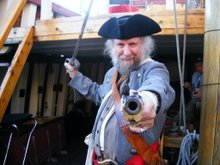
Have you ever noticed how few pirate movies actually feature acts of piracy? Here's an example of what I mean.
Pirates of the Caribbean I - Barbossa and the crew of the Black Pearl are proper pirates. We get our first glimpse of the Pearl as having just sunk a merchant ship. Later the crew of the Pearl sack Port Royal. But what of Jack Sparrow? We first see him in a leaky boat. He admires the Interceptor then rescues Elizabeth and is arrested for past charges. While a list of charges is read at his hanging, we never see him doing anything that deserves a death sentence except possibly the commandeering of the Interceptor (which Will was pardoned for). In fact, this is a sore point for the crew in the second movie. They are hoping for "something shiny". It appears that Jack hasn't been much of a pirate captain which would be why they abandon him at the end of the third movie.
Will and Elizabeth are arrested for helping pirates (specifically Jack). Will commands various ships and Elizabeth becomes the pirate king but neither actually practices any piracy (except for the Interceptor).
What about the prototype pirate, Long John Silver? He certainly had some disreputable deeds in his past but, like Jack, we don't see much of them. When he first appears he is a tavern owner who signs on as ship's cook. He does lead a mutiny but that is different from piracy.
Captain Morgan on Cutthroat Island is another pirate who is wanted for past, mainly unexplained deeds, but is currently engaged in treasure hunting rather than piracy.
If you want a real pirate then look to Captain Blood. Even here he has to have justification so we see him torn from his medical practice for helping a rebel and sold as a slave. From there his only alternative is escape and piracy. Even here he is a moral pirate, mainly attacking the evil Spanish and eventually being pardoned.
There is a simple reason for all of this. We are meant to sympathize with the pirates so their harsher nature is hidden. It's hard to root for someone while he's robbing and torturing the innocent. Of course, this hides a lot of the real nature of pirates. We end up with guys in tricorns who say "arr" a lot and spend their time looking for buried treasure.
Tuesday, June 17, 2008

Tuesday, June 3, 2008
Taking the helm
Being at the whipstaff of the Half Moon was enlightening.
For those who are not familiar with the whipstaff, it was used to steer large ships during most of the 16th and 17th centuries. As recently as Columbus, ships had a single deck and were steered with a tiller. When additional decks were added, they added the whipstaff. The whipstaff it a pole with a collar that attaches to the tiller. There is a pivot point where it goes through the upper deck. The person at the helm pushes the whipstaff which then moves the tiller. This was, the helmsman can see out (at least to the sides) and, more importantly, can hear commands.
The hard thing about the whipstaff is which way you move it. Anyone who has used a tiller is used to moving the tiller right to turn left. This is switched with the whipstaff. You push it to the left to turn left.
There is an effort to moving the whipstaff. Also, if you push it all the way to one side then it slides down through the pivot and you have to pull it back up to center it again. An hour at the whipstaff is tiring.
At times the captain simply gives orders about how the ship should be steered - left 1/4, right 1/2, etc. Other times he would point to a landmark in the distance and ask that this be kept close to the port or starboard. At sea the captain would give a compass heading and the helmsman would use the compass in the binacle which is right in front of him. At these times he doesn't even need to see out.
The captain pointed out that the tiller doesn't really move much - maybe 15 degrees each way. The tiller acts more as a trim tab. The real work in turning the ship is done with the sprit sail and the mizzen. These pull the front or back the ship around.
The ship's wheel was invented around 1690 and became popular in the early 18th century. It had cables that went to the tiller. Turning the wheel pulls the cables, moving the tiller right or left. This has several advantages. The wheel can be mounted higher. Because of ratios, it cam make turning the ship easier. It can pull the tiller further to either side. And, it can be tied off as needed.
Regardless, steering the ship was not something that a captain normally did. In a tricky situation the captain would want to be mobile rather than stuck at one spot.
For those who are not familiar with the whipstaff, it was used to steer large ships during most of the 16th and 17th centuries. As recently as Columbus, ships had a single deck and were steered with a tiller. When additional decks were added, they added the whipstaff. The whipstaff it a pole with a collar that attaches to the tiller. There is a pivot point where it goes through the upper deck. The person at the helm pushes the whipstaff which then moves the tiller. This was, the helmsman can see out (at least to the sides) and, more importantly, can hear commands.
The hard thing about the whipstaff is which way you move it. Anyone who has used a tiller is used to moving the tiller right to turn left. This is switched with the whipstaff. You push it to the left to turn left.
There is an effort to moving the whipstaff. Also, if you push it all the way to one side then it slides down through the pivot and you have to pull it back up to center it again. An hour at the whipstaff is tiring.
At times the captain simply gives orders about how the ship should be steered - left 1/4, right 1/2, etc. Other times he would point to a landmark in the distance and ask that this be kept close to the port or starboard. At sea the captain would give a compass heading and the helmsman would use the compass in the binacle which is right in front of him. At these times he doesn't even need to see out.
The captain pointed out that the tiller doesn't really move much - maybe 15 degrees each way. The tiller acts more as a trim tab. The real work in turning the ship is done with the sprit sail and the mizzen. These pull the front or back the ship around.
The ship's wheel was invented around 1690 and became popular in the early 18th century. It had cables that went to the tiller. Turning the wheel pulls the cables, moving the tiller right or left. This has several advantages. The wheel can be mounted higher. Because of ratios, it cam make turning the ship easier. It can pull the tiller further to either side. And, it can be tied off as needed.
Regardless, steering the ship was not something that a captain normally did. In a tricky situation the captain would want to be mobile rather than stuck at one spot.
Sailing the Half Moon

I spent the weekend at the School of the Sailor on the Half Moon. This is a reconstruction of the ship Henry Hudson used in his 1609 voyage. Some of the photos I took are here. The official web site for the event is here.
I got to do some things that most pirate reenactors never do - I spent a weekend living on a 17th century ship, working the sails, and taking the helm (I spent two 1-hour shifts at the whipstaff).
In addition to sailing, we also did some live fire. I shot a dog-lock musket and an English-lock pistol. There was also a matchlock but I've live-fired my own. We also sang sea shanties and broke into smaller groups to concentrate on specific skills like navigation and knot work.
The event was educational.
The Half Moon is rated at around 100 tons (the size of the cargo hold) which is similar to the Santa Maria but it felt a lot smaller. The difference must be in the depth of the hold. I'm sure that the main deck on the Santa Maria is much larger than the weather deck on the Half Moon.
On the other hand, the Half Moon has an orlop deck which is where we slept.
The Half Moon would make a fairly decent pirate ship. It is fairly handy. It would require more guns. It only have a pair of 2-pounders and a pair of swivel guns.
It would also require cleaning up the ship's lines. The captain pointed out that the cabins present as much surface area to the wind as most sail boats. This makes it harder to steer. The wind can catch the rear of the ship and blow it sideways.
This part of the ship is there so that the captain and crew can live in some comfort. Pirates often removed these structures to improve their speed and maneuverability.
Thursday, May 1, 2008
Portable Piracy

How does the modern pirate adapt? He uses a fold-up urban skiff.
Think of the possibilities. No one would expect you to fold out what looks like an oversize golf bag into an actual sailing vessel. Of course, it won't take much to swamp this thing but it's easier to carry around than a hollowed out log.

Musketry
I've been reading the section on small-arms in Sea Rover's Practice. What he describes as a pirate gun is pretty close to the Brown Bess. It is the same size, muzzle bore, and general shape. This is basically a 10-gage barrel firing a .75 round ball.
According to the book, pirates increased their rate of fire by thumping the butt against the ground instead of ramming it with the scouring stick (aka ramrod).
I have quite a bit of experience firing blanks from similar pieces and some experience with live fire. Also, most of my experience has been doing earlier periods which gives me a different point of view.
Thumping the gun instead of ramming is common during reenactments. If you don't use the scouring stick you aren't going to leave it in the barrel. I don't see any problem doing this with a loose ball. Even with the fouling from several shots, the ball will still be loose enough to go down all the way with a little thump.
A ball with wadding is a completely different matter. I've never tried firing it this way. When I fire with wadding or a patch it takes some effort to get the ball down the barrel.
So how did the pirates do it? I'm betting that they didn't bother wadding. This is where my early-period experience gives me a different perspective.
Paper cartridges were known for over a century by the GAoP but they were not used by the infantry until late in the 17th century. Instead they used a bandoleer with wood or tin chargers hanging from a leather belt.
Paper cartridges were used by cavalry and civilians. Later cartridges had a ball as part of the cartridge but for most of the 17th century a cartridge was just a powder charge rolled in paper. You bit off the end, poured a bit in the priming pan then poured the rest down the barrel. You carried balls in your mouth and spit one down the barrel after the charge.
Later they started including the ball at the end of the cartridge. The powder would be poured down then the empty cartridge with the ball attached stuffed into the barrel.
So, did the pirates attach a ball to the cartridge? I'm guessing that they did not which is how they kept up the rate of fire.
When I am doing live fire I usually use a patch with my ball. I know people who insist that this is not needed but I find that it help with accuracy. Without a patch a loose ball can start to roll down the barrel. This makes it deflect a bit in the direction it is rolling. Chances are pretty good that it will roll a different direction the next shot. The deflection isn't much - a few inches over 50 yards - but this can make the difference between hitting and missing a target. With a patch the ball can't roll so it is more consistent. This means that there are trade-offs. If you want a more accurate shot you have to take longer loading.
On the other hand, if you are firing in the general direction of the enemy you might just add more shot. You might load with two balls or a combination of a large ball and three or more smaller ones known as buck and ball. We know that this load was used as early as Jamestown. The first body discovered in the original settlement had been shot in the knee from behind with this charge (probably an accident).
Since cartridges with attached balls were still brand new during the GAoP, mmy guess is that pirates didn't bother with them. Their first load might include buck and ball with a cartridge rammed on top of it to keep the shot in place but reloads would just be a ball which would be kept in the mouth. The cartridge would be discarded. That would give the fastest rate of fire.
According to the book, pirates increased their rate of fire by thumping the butt against the ground instead of ramming it with the scouring stick (aka ramrod).
I have quite a bit of experience firing blanks from similar pieces and some experience with live fire. Also, most of my experience has been doing earlier periods which gives me a different point of view.
Thumping the gun instead of ramming is common during reenactments. If you don't use the scouring stick you aren't going to leave it in the barrel. I don't see any problem doing this with a loose ball. Even with the fouling from several shots, the ball will still be loose enough to go down all the way with a little thump.
A ball with wadding is a completely different matter. I've never tried firing it this way. When I fire with wadding or a patch it takes some effort to get the ball down the barrel.
So how did the pirates do it? I'm betting that they didn't bother wadding. This is where my early-period experience gives me a different perspective.
Paper cartridges were known for over a century by the GAoP but they were not used by the infantry until late in the 17th century. Instead they used a bandoleer with wood or tin chargers hanging from a leather belt.
Paper cartridges were used by cavalry and civilians. Later cartridges had a ball as part of the cartridge but for most of the 17th century a cartridge was just a powder charge rolled in paper. You bit off the end, poured a bit in the priming pan then poured the rest down the barrel. You carried balls in your mouth and spit one down the barrel after the charge.
Later they started including the ball at the end of the cartridge. The powder would be poured down then the empty cartridge with the ball attached stuffed into the barrel.
So, did the pirates attach a ball to the cartridge? I'm guessing that they did not which is how they kept up the rate of fire.
When I am doing live fire I usually use a patch with my ball. I know people who insist that this is not needed but I find that it help with accuracy. Without a patch a loose ball can start to roll down the barrel. This makes it deflect a bit in the direction it is rolling. Chances are pretty good that it will roll a different direction the next shot. The deflection isn't much - a few inches over 50 yards - but this can make the difference between hitting and missing a target. With a patch the ball can't roll so it is more consistent. This means that there are trade-offs. If you want a more accurate shot you have to take longer loading.
On the other hand, if you are firing in the general direction of the enemy you might just add more shot. You might load with two balls or a combination of a large ball and three or more smaller ones known as buck and ball. We know that this load was used as early as Jamestown. The first body discovered in the original settlement had been shot in the knee from behind with this charge (probably an accident).
Since cartridges with attached balls were still brand new during the GAoP, mmy guess is that pirates didn't bother with them. Their first load might include buck and ball with a cartridge rammed on top of it to keep the shot in place but reloads would just be a ball which would be kept in the mouth. The cartridge would be discarded. That would give the fastest rate of fire.
Monday, April 28, 2008
Pirates of the Scioto
My wife and I decided to try to start a local pirate group, the Pirates of the Scioto. I started a Yahoo Group for this and I asked the Santa Maria about being able to hold pirate events on the ship. If I get an ok then I will put up a recruiting posted at the ship.
What we want the group to be is an extension of how we have approached recreating piracy - keep the basics accurate but allow some things to be over-the-top because, after all we are pirates.
I'd like to see keep costumes based on late 17th/early 18th century clothing, especially sailor's clothing. At the same time, if we keep it too accurate then no one will know that we are pirates.
What we want the group to be is an extension of how we have approached recreating piracy - keep the basics accurate but allow some things to be over-the-top because, after all we are pirates.
I'd like to see keep costumes based on late 17th/early 18th century clothing, especially sailor's clothing. At the same time, if we keep it too accurate then no one will know that we are pirates.
Monday, April 21, 2008
Pyratecon 2008


Pyratecon has come and gone. I didn't hear the official attendance but the organizers were hoping for 1,000 with 600 pre-registered before the event started.
With those numbers, several of the venues were too small. The pirate party Thursday night was fine. The bar was full but there was plenty of room outside and it was a nice night. The pirate dinner Friday night was far too crowded. Organizers asked people to stagger their arrival but the first ones in didn't leave so it just got more and more crowded. At one point I heard a waitress wonder if the balcony could hold everyone. The first band was good but it was hard to hear them. I would have liked them to play longer. The second band wasn't as good although they were acceptable. The bar events on Saturday night were a lost cause. If you were lucky you could stand close enough in Bourbon Street to see the bar.
The dealer rooms were a little crowned on Friday morning but things thinned out over time. I would have liked to see more vendors selling historically accurate items but that's me.

We went to most of the workshops and talks. They were all good and were under-attended. The sea-chantey workshops were especially fun. The celebrity actors from Pirates of the Caribbean: the Curse of the Black Pearl were interesting. They all played small but important parts as members of the cursed crew. None were in the sequels (no surprise, TBS showed the movie Sunday and I noticed that all three were killed outright or blown to bits). They were all interesting characters and happy to be part of the festivities.
The Saturday night parade was a huge success. Hundreds of pirates marched (swaggered?) up Bourbon Street, watched by thousands of people. The only problem was at the end when most of the parade wanted to keep going past past the Funky Pirate bar that was the official end.
So - who attends a pirate convention? There were several different types.
At the low end were the semi-pirates. These were people who had some sort of costume. There were some people who could (and probably did) wear the same outfits to goth bars and ren fairs. A lot of people had fancy costumes - red or black silk shirts, brocade coats, etc. Then there were the historic pirates. That's the group we were part of. Then there were the people doing specific characters. We saw a very good Blackbeard, eight or nine Jack Sparrows, two Barbosas, a Tia Dalma, and a couple of British Naval Officers who might have been doing Norington.

There were also a couple of ninjas which seems like asking for trouble.
A lot of locals got into the act. We noticed several costume-shop pirates in the French Quarter after the parade. Outfits like these. I always wondered where someone could wear one of these outfits in public - the French Quarter.

Subscribe to:
Posts (Atom)