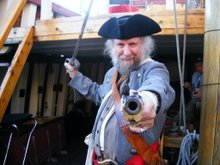
In general, pirates did not create any new weapons. They simply used weapons that were in common use at the time. Still, there are differences between what pirates used and how they used them and how weapons were used in general in the GAoP (Golden age of Piracy).
A pirate's favorite weapon was the pistol. This is the biggest difference between them and the rest of the population. Pistols were normally used by civilians and officers. Regular soldiers were not issued pistols.
A pistol is generally a short-range weapon. Black powder expands slowly and a long barrel is needed in order to give the powder enough time to accelerate a ball to maximum speed. The shorter barrel means that the ball will be traveling substantially slower. In addition, pistols usually shot smaller balls than a musket. This means that a pistol ball will fall short before a musket ball does and that a pistol ball does not have the penetrating power of a musket ball.
There are other problems with pistols. Firing one-handed is not as accurate as firing a gun resting on the shoulder and steadied with both hands. A musket is carried muzzle-up while a pistol is usually carried muzzle-down. This means that a musket ball does not need to be tight-fitting which, in turn, speeds up loading. If a pistol is loaded with a loose-fitting ball and stuffed in a sash, the ball will fall out. A tight-fitting ball takes longer to load since it has to be forced down the barrel.
So why would pirates prefer a pistol? It has to do with the types of fights they had.
Ships are small. Even the largest ship of the time measured from stem to stern was barely as long as standard battlefield distances. If you are fighting on a ship you are going to be close enough that the problems with range and penetrating power do not matter. The same is true with aiming. You shoot at someone who is directly in front of you. The chance that you will actually hit him is higher than the odds of hitting someone at standard musket distances.
Pirates had a simple solution for the slow reloading time. They carried multiple pistols.
Muskets on the other hand, are difficult to use in close-quarter combat; you cannot carry more than one at a time; and loading them in a melee or on a small boat is difficult. Which doesn't mean that muskets were not used, just that they were confined to ship-to-ship fighting or land-invasion.
The infamous blunderbuss is another weapon that was mainly used by civilians and pirates. It is basically a sawed-off shotgun and is most effective against a group at close range.
The carbine is probably under-represented among pirate reenactors. This is a shortened musket. It was mainly used by cavalry and could be carried on a shoulder sling. There was also a naval version. The carbine had a greater range and penetrating power than a pistol and could be loaded faster than a pistol or musket but the short barrel made it easier to use in a crowd or on a small boat. If it was carried on a sling then it would need a tight-fitting ball.
Cannons are another example of a weapon being used differently. Unlike most naval battles, pirates seldom wanted to sink the ship that they were attacking nor did they want to cause too much damage if it was a ship that they might want to take as a prize. That limited their choices in ammunition. The best choices for pirates would be canister shot or grape shot. This was a load of musket balls which turned a cannon into a huge, powerful shotgun capable of decimating a crew but sparing the ship. Bar shot and chain shot might also be used. These were effective anti-personnel loads but they could also be used to disable a ship's sails, rigging, and masts.
Swords are a special case. Through the middle of the 17th century, some troops were issued swords and some were not. Officers and cavalry always had them. Pikemen (pikes are 16-20 foot-long spears) often had them. Musketeers usually did not carry swords. It is difficult to use a sword while carrying a musket so musketeers depended on the pikemen for protection from hand-to-hand combat or used their muskets as clubs.
At sea, hand to hand combat is the norm rather than the exception so most people had a sword or alternate cutting implement such as a boarding ax.
Finally, grenades were known but seldom used on the battlefield for the simple reason that it was hard to pitch one into the right place at the right time. Again, given the closer quarters of a fight on a ship, a grenade could be more easily used.
Friday, June 12, 2009

Tuesday, June 9, 2009
Hampton Blackbeard Festival
We were at the Hampton Blackbeard Festival over the weekend. This is an impressive festival. Unlike most pirate festivals, the Blackbeard Festival actually has some ties to pirates and Blackbeard. He raided the eastern coast until the Governor of Virginia decided to put a stop to it. Two sloops were sent out to capture or kill Blackbeard and his crew. They were successful and returned with Blackbeard's head and several members of his crew who were tried in near-by Williamsburg. Blackbeard's head was placed on a pike int he James River as a warning to other pirates. According to legend, this was at or near Hampton.
The modern-day festival is in its 8th year. There were no attendance figures but thousands attended and estimates based on food sales put the crowd at an all-time high.
At the heart of the festival is Pirate's Cove, an encampment of accurate pirate reenactors along with some sutlers and performers. Further out were the non-period vendors and performers. Four ships and three boats participated. Three of the ships played the parts of the sloops, reenacting Blackbeard's last stand. After that, the three smaller boats did a tactical.
Unfortunately the number of reenactors has outgrown the Pirate's Cove so a small, grassy area along the waterfront was also used for reenactors. This was assigned to the Crew of the archangle which we fell in with. This kept us somewhat away from the main event.
I provided one of the small boats - the smallest one. My Whitehall fit in nicely with the two larger boats. All had similar lines. They just differed in size. The tactical involved pirates stealing the largest boat, the Explorer, then fighting the middle-sized boat over who could take our boat. This meant that both boats were chasing us much of the time.
The Whitehall was up to the challenge. With two people rowing, one streering, and one at the swivel gun, we easily outmanuvered and outsped the larger boats. On Sunday the three small craft exchanged fire with one of the sloops before going to the boat ramp. Again, with five people aboard and two rowing, we easily passed the middle boat which had four or five people and three rowing.
Many of the local boats were decorated. Most simply had pirate flags but some had elaborate decorations including treasure chests and pirate figures. Many of the locals had pirate costumes.
The most bizzare thing was how many of the women on boats were calling out invitations to us as we rowed past - things like, "I want to be plundered!" One woman was dressed as a parrot and wanted a pirate to adopt her. I wonder what these women's husbands and boyfriends thought?
The weather could have been better and it could have been worse. It poured rain on Friday afternoon and evening and the camp sites were a soggy mess for the rest of the weekend. The rain gave way to simply being overcaston Saturday and sunny on Sunday. The temperatures were lower than normal for Virginia in June which was a blessing when rowing a boat.
The modern-day festival is in its 8th year. There were no attendance figures but thousands attended and estimates based on food sales put the crowd at an all-time high.
At the heart of the festival is Pirate's Cove, an encampment of accurate pirate reenactors along with some sutlers and performers. Further out were the non-period vendors and performers. Four ships and three boats participated. Three of the ships played the parts of the sloops, reenacting Blackbeard's last stand. After that, the three smaller boats did a tactical.
Unfortunately the number of reenactors has outgrown the Pirate's Cove so a small, grassy area along the waterfront was also used for reenactors. This was assigned to the Crew of the archangle which we fell in with. This kept us somewhat away from the main event.
I provided one of the small boats - the smallest one. My Whitehall fit in nicely with the two larger boats. All had similar lines. They just differed in size. The tactical involved pirates stealing the largest boat, the Explorer, then fighting the middle-sized boat over who could take our boat. This meant that both boats were chasing us much of the time.
The Whitehall was up to the challenge. With two people rowing, one streering, and one at the swivel gun, we easily outmanuvered and outsped the larger boats. On Sunday the three small craft exchanged fire with one of the sloops before going to the boat ramp. Again, with five people aboard and two rowing, we easily passed the middle boat which had four or five people and three rowing.
Many of the local boats were decorated. Most simply had pirate flags but some had elaborate decorations including treasure chests and pirate figures. Many of the locals had pirate costumes.
The most bizzare thing was how many of the women on boats were calling out invitations to us as we rowed past - things like, "I want to be plundered!" One woman was dressed as a parrot and wanted a pirate to adopt her. I wonder what these women's husbands and boyfriends thought?
The weather could have been better and it could have been worse. It poured rain on Friday afternoon and evening and the camp sites were a soggy mess for the rest of the weekend. The rain gave way to simply being overcaston Saturday and sunny on Sunday. The temperatures were lower than normal for Virginia in June which was a blessing when rowing a boat.
Monday, June 1, 2009
Ebay Pirate Ship
I've liked to ebay auctions before. This is a nice little boat. The owner calls it a ship but it is really a 12 foot rowable sailboat with a sprit for the jib (that's the pole sticking out the front for the leading sail for landlubbers). I'd be interested myself if I didn't already have a bigger boat.
Sunday, May 31, 2009
Sailing the Whitehall
We've taken the Whitehall out the last couple of Saturdays. Last week there was no wind at all so I tried the rowing seat. It worked quite well with my legs doing most of the work. I rowed a mile and a half to two miles and I never had to breath hard.
This week there was some wind so I finally got to try the sails.
Technically it was what is know as light wind. I think the wind was in the 5-10 mph range. This is a good windspeed for trying sailing since there is enough wind to get you moving but not enough to cause problems.
The Whitehall sails really well. I was pretty much able to go anywhere I wanted. There were a couple of times that the wind died and we did one tack as the wind was dying. I was able to use the job to get us out of that.
When the wind was blowing from the side or slightly ahead of us the boat really sped along. A few times I was overtaking modern sailboats going the same direction.
I was cautious. I could have gotten more speed out of her but I didn't want to get the side too close to the water so I slacked off sail a bit. We still had to lean into the wind.
I was especially proud that I was able to pull right up to the dock and grab a cleat with my boathook.
I tried it with the centerboard up and down. I couldn't tell the difference. The Whitehall is designed to move in a straight line so the centerboard may be superfluous.
I ordered a couple of new cleats for the rail. I had been using a pair of cleats meant for controlling the job when single-handing. These are rather small and are forward of where I wanted them. I found some reasonably-priced bronze cleats on-line and got them in time to install them Friday. They helped a lot in controlling the boat at a dock. I really wonder why no one ever installed a pair before?
A couple of improvements I need to make before we go to the Hampton Blackbeard Festival next week - I improvised a brail line for taking in the sail in a hurry. I'm going to replace it with one that is longer and a different type of rope. I want to be able to identify it easily since this is what we will use if we need to take in the sail in an emergency. Along the same lines, I am going to use a small carabiner to attach the boom to traveler. I want to be able to detach this quickly in an emergency. Taking the traveler line free takes too long. Yesterday I had to use a marlinspike to get the stopper knot out. With the carabiner I can leave the line permanently attached.
I need some way to be able to tie off the tiller. I used the long one and it kept swinging wide. At dock it kept getting caught on the dock. When sailing it would swing out of reach if I took my hand off of it to pump out the boat. Maybe I can rig up something with the new cleats.
This week there was some wind so I finally got to try the sails.
Technically it was what is know as light wind. I think the wind was in the 5-10 mph range. This is a good windspeed for trying sailing since there is enough wind to get you moving but not enough to cause problems.
The Whitehall sails really well. I was pretty much able to go anywhere I wanted. There were a couple of times that the wind died and we did one tack as the wind was dying. I was able to use the job to get us out of that.
When the wind was blowing from the side or slightly ahead of us the boat really sped along. A few times I was overtaking modern sailboats going the same direction.
I was cautious. I could have gotten more speed out of her but I didn't want to get the side too close to the water so I slacked off sail a bit. We still had to lean into the wind.
I was especially proud that I was able to pull right up to the dock and grab a cleat with my boathook.
I tried it with the centerboard up and down. I couldn't tell the difference. The Whitehall is designed to move in a straight line so the centerboard may be superfluous.
I ordered a couple of new cleats for the rail. I had been using a pair of cleats meant for controlling the job when single-handing. These are rather small and are forward of where I wanted them. I found some reasonably-priced bronze cleats on-line and got them in time to install them Friday. They helped a lot in controlling the boat at a dock. I really wonder why no one ever installed a pair before?
A couple of improvements I need to make before we go to the Hampton Blackbeard Festival next week - I improvised a brail line for taking in the sail in a hurry. I'm going to replace it with one that is longer and a different type of rope. I want to be able to identify it easily since this is what we will use if we need to take in the sail in an emergency. Along the same lines, I am going to use a small carabiner to attach the boom to traveler. I want to be able to detach this quickly in an emergency. Taking the traveler line free takes too long. Yesterday I had to use a marlinspike to get the stopper knot out. With the carabiner I can leave the line permanently attached.
I need some way to be able to tie off the tiller. I used the long one and it kept swinging wide. At dock it kept getting caught on the dock. When sailing it would swing out of reach if I took my hand off of it to pump out the boat. Maybe I can rig up something with the new cleats.
Tuesday, May 12, 2009
Pirates on the Santa Maria - 2009


The attack on the ship wasn't as well planned as I would have liked but it worked. We had scratch crews manning guns on the Santa Maria. A new unit brought a small mortar so some experienced gunners fired that while the new people fired a howitzer from the shore. I quickly trained someone on using my swivel gun and she did a great job with some assist from someone who had helped me last year.
I was on my boat attacking the ship with a small swivel gun and hand-arms. We also had a couple of people on the jetty and defenders firing from the quarter deck.
After the ship closed on Saturday there was a lot of posing for pictures. Most pirates reenactors don't get to take over a ship long enough to do extended photo ops.
Around 15 people spent the night on the ship. There were some complaints about how hard the deck is to sleep on and how cold it was (the low was in the upper 40s). One thing I like about pirate events is that people sleep late. Usually I'm one of the last up at reenactments but I am usually one of the first at pirate events.
Sunday's battle was slightly scaled down. Several people could only be there for Saturday and we were out of powder for my swivel gun. We still managed a credible battle.
People started packing in earnest after the battle and were pretty much gone by 4:00. This was a shame since the ship still had visitors but it is a fact of life for reenactments where people come from out of town.
Monday, May 11, 2009
Getting the Whitehall in the Water
In the last few weeks I managed to finish sanding and painting the Whitehall and get it ready to put in the water. I spent the last two weeks before launching it pouring water into it to swell the planks. I saw this recommended as a way of avoiding the "Oh my God, my boat's sinking!" feeling when a wood planked boat is put in the water after a long haul-out. I'm glad I did this. When I first started soaking the hull, water poured out. Later it still dribbled out.
We got it in the water down a nasty boat ramp. The car got stuck in some wet mud (silt) and we had to get some help to get it loose. While we waited for a tow chain, I rowed the Whitehall around a bit. It handled fine.
The occasion was a pirate event at the Santa Maria which is 1/2 mile from the boat launch. After we got the car free, I set off with a volunteer crew. I didn't have the rudder on yet so we steered with the oars and a paddle that I used from the bow. The boat took a on a bit of water but not too much.
I checked it regularly. By nightfall it had stopped taking in water. It still leaks when people are in it. The extra weight forces the boat lower in the water and water seeps in past planks that have not swollen shut yet. If I could just have three or four people sit in the boat for 6-8 hours then this leak would swell shut, also.
We used it for the battle both days. We had three people the first day and four the second. Michael and I also went out with the wives. The boat is fine with four people - not crowded at all. We could fit in a fifth person. Any more than that would be crowded.
It rows well. It has three rowing stations but only two sets of oars. I decided that this is so that one person can row from the middle station (the sliding rowing seat and the foot pedals for the tiller are both set up for here. If you have two people rowing then it is better to have them in the first and third rowing stations. That way the oars don't have to be in perfect unison.
The swivel gun mount I rigged up on the bow worked perfectly. The small gun I have is quite loud, especially with a double charge.
We had three people on the way back to the boat ramp - two rowing and one at the tiller. I could tell the difference when I was rowing by myself but it wasn't a lot harder. A half-hour row upstream wasn't enough to make me breath hard. My hands where the main thing that got tired although I could feel it later.
We did have some trouble with the oars and the oarlocks, especially with the "sweeps" - the traditionally shaped oars. I used those on the row to the boat ramp and the collars that are supposed to keep the oar from going too far up the oarlock are too small. I need to do something to make these bigger.
Other that that, everything worked fine. Now I want to try sailing it but that will have to wait a couple of weeks.
We got it in the water down a nasty boat ramp. The car got stuck in some wet mud (silt) and we had to get some help to get it loose. While we waited for a tow chain, I rowed the Whitehall around a bit. It handled fine.
The occasion was a pirate event at the Santa Maria which is 1/2 mile from the boat launch. After we got the car free, I set off with a volunteer crew. I didn't have the rudder on yet so we steered with the oars and a paddle that I used from the bow. The boat took a on a bit of water but not too much.
I checked it regularly. By nightfall it had stopped taking in water. It still leaks when people are in it. The extra weight forces the boat lower in the water and water seeps in past planks that have not swollen shut yet. If I could just have three or four people sit in the boat for 6-8 hours then this leak would swell shut, also.
We used it for the battle both days. We had three people the first day and four the second. Michael and I also went out with the wives. The boat is fine with four people - not crowded at all. We could fit in a fifth person. Any more than that would be crowded.
It rows well. It has three rowing stations but only two sets of oars. I decided that this is so that one person can row from the middle station (the sliding rowing seat and the foot pedals for the tiller are both set up for here. If you have two people rowing then it is better to have them in the first and third rowing stations. That way the oars don't have to be in perfect unison.
The swivel gun mount I rigged up on the bow worked perfectly. The small gun I have is quite loud, especially with a double charge.
We had three people on the way back to the boat ramp - two rowing and one at the tiller. I could tell the difference when I was rowing by myself but it wasn't a lot harder. A half-hour row upstream wasn't enough to make me breath hard. My hands where the main thing that got tired although I could feel it later.
We did have some trouble with the oars and the oarlocks, especially with the "sweeps" - the traditionally shaped oars. I used those on the row to the boat ramp and the collars that are supposed to keep the oar from going too far up the oarlock are too small. I need to do something to make these bigger.
Other that that, everything worked fine. Now I want to try sailing it but that will have to wait a couple of weeks.
Tuesday, May 5, 2009
Pet Peeves
There are a lot of things that show up at historic festivals that shouldn't. Many of these have jumped from celtic and Renaissance festivals.
Bodhrons - Those flat drums that are played on-handed. I don't object to them as instruments. I know several talented bodhron players. Unfortunately, none of them come to historic events. The people who pull these out at historic events seldom have any idea how to play them properly. You are supposed to press your left hand against the skin from the back, changing the tone as you play. You hold the beater like a pencil and only use one end with a sort of brushing motion. When played properly, it is a rather soft instrument and one of the few drums that isn't a monotone.
Even if played correctly, these instruments are inappropriate. Some people trace them back hundreds of years. Others say that they were an agricultural tool that was occasionally used for rhythm in very poor, agricultural areas of Ireland and not a part of mainstream Irish music until the 1970s. Either way, they were obscure before the late 20th century.
Utilikilts - A proper kilt is a long piece of wool, folded into pleats and belted into a garment. Later (we're talking Victorian period) the pleats were sewn into the kilt to make it easier to put on. In the 1990s, some Americans started making kilts out of heavy cotton with wide pleats sewn in and snap closures. These are fine for celtic fesitvals but out of place at historic events. I have one but I am selective where I wear it.
Irish Music - It used to be that you heard lots of old folk music at historic events. These days it is pretty much limited to 19th and 20th century Irish music. Don't get me wrong - I love Irish music and play in Irish sessions a few times a month, but most of it is out of period for anything earlier than the Civil War.
Bodhrons - Those flat drums that are played on-handed. I don't object to them as instruments. I know several talented bodhron players. Unfortunately, none of them come to historic events. The people who pull these out at historic events seldom have any idea how to play them properly. You are supposed to press your left hand against the skin from the back, changing the tone as you play. You hold the beater like a pencil and only use one end with a sort of brushing motion. When played properly, it is a rather soft instrument and one of the few drums that isn't a monotone.
Even if played correctly, these instruments are inappropriate. Some people trace them back hundreds of years. Others say that they were an agricultural tool that was occasionally used for rhythm in very poor, agricultural areas of Ireland and not a part of mainstream Irish music until the 1970s. Either way, they were obscure before the late 20th century.
Utilikilts - A proper kilt is a long piece of wool, folded into pleats and belted into a garment. Later (we're talking Victorian period) the pleats were sewn into the kilt to make it easier to put on. In the 1990s, some Americans started making kilts out of heavy cotton with wide pleats sewn in and snap closures. These are fine for celtic fesitvals but out of place at historic events. I have one but I am selective where I wear it.
Irish Music - It used to be that you heard lots of old folk music at historic events. These days it is pretty much limited to 19th and 20th century Irish music. Don't get me wrong - I love Irish music and play in Irish sessions a few times a month, but most of it is out of period for anything earlier than the Civil War.
Subscribe to:
Posts (Atom)