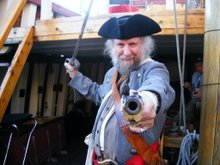
It's finally out and it was worth the wait. In many ways this is the movie I was hoping that PotC 2 would be. The feel of it is much closer to the original. While Jack's motivations are always in doubt, everything else it pretty straightforward. It is also a Jack-centric movie. There are very few scenes that do not feature Captain Jack. This is fine with me since he was always the big draw in the previous movies.
Just a handful of regulars from the other movies make it into this one - mainly Barbossa and Gibbs with a couple of cameos by Jack the Monkey. We think we spotted a British officer from the original but he has no lines. The new cast also gives the movie a fresh feel.
The third movie ended with Jack starting on a quest for the Fountain of Youth. This movie picks up there. It seems that Jack has not been successful although he has not given up. In the meantime, the Spanish get a clue to the Fountain and launch an expedition. King George II does not want the Spanish to have sole access to the fountain and sends his own expedition commanded by Barbossa who managed to lose the Black Perl and a leg. Also racing to find the Fountain are Blackbeard who is trying to stave off his prophesied death and his daughter who, like Jack wants a few extra decades of youth.
The movie is much darker than the others, both figuratively and literally. Blackbeard is bloodthirsty and most of the scenes take place at night or on cloudy days.
The movie is a bit scaled back from the third movie which spent a rumored half-billion dollars but it has a very large budget. The main thing missing is over-the-top special effects. This movie does not use two full-sized gimbal-mounted ships or a cast that is half-CGI.
On Stranger Tides does feature early-18th century London and an unnamed island (Hawaii) which gives it a very lush look. Rob Marshall, the new director, improves the cinematography so it is actually a better-looking movie.
I didn't notice any references to the PotC ride in the movie but there are several references to the prior movies - just enough to let people know that this actually is PotC movie.
I only have a couple of complaints. The action is mainly front-loaded. The movie begins with several set-pieces and compared with them the ending is almost anti-climactic. Similarly, there is nothing comparable with the skeletal duel between Jack and Barbossa from the first movie. The closest thing is the fight with the mermaids which comes earlier. This does not mean that the ending was unsatifying, just not as memorable as in previous movies.
Two final notes - fans of Tim Powers' book On Stranger Tides should not expect to see much of the book in the movie. The credits say "inspired by". This consists of giving Blackbeard supernatural powers and having a quest for the Fountain of Youth.
Also, zombie enthusiasts will be disappointed by the movie's zombies. They are ugly and unkillable but nothing like the brain-hungry monsters in pop-culture.
Friday, May 20, 2011

Wednesday, May 18, 2011
Will Pirates 4 Be Any Good?
The first review of PotC:On Stranger Tides is out and the reviewer didn't like it. Of course, the reviewer seems mystified that anyone liked the first three. As a side note, she is also unaware that brain-eating zombies are a recent cinematic invention and that the zombies of folklore were corpses reanimated as servants.
Anyway, I distinctly remember a number of bad reviews of the first three movies. Critics felt that the original one was too long and repetitious. I suspect that big-name movie critics feel that reviewing pirate movies is beneath them.
I readily admit that PotC 2 was not as good as PotC 1 and that PotC 3 fell somewhere in-between. Disney was in such a hurry to shoot the movies that they didn't wait for a finished script so dropped plot threads abound. Also, I can understand why they wanted to keep Will and Elizabeth in the movies but their storyline really ended at the end of the first movie. That complication has been dropped and Depp assures us that the script is more like the original.
I have no idea how they will adapt On Stranger Tides. The book is about a puppeteer who accidentally becomes a pirate. Probably the subplots about Blackbeard and magic are used.
One thing I am hoping for is the return of some actual pirates to the franchise. Except for the sack of Port Royal early in the first movie no one engaged in any piracy. In the second and third movies, the pirates were the good guys and the villains were not pirates. Maybe Blackbeard will add some piracy to the Pirates franchise.
Anyway, I distinctly remember a number of bad reviews of the first three movies. Critics felt that the original one was too long and repetitious. I suspect that big-name movie critics feel that reviewing pirate movies is beneath them.
I readily admit that PotC 2 was not as good as PotC 1 and that PotC 3 fell somewhere in-between. Disney was in such a hurry to shoot the movies that they didn't wait for a finished script so dropped plot threads abound. Also, I can understand why they wanted to keep Will and Elizabeth in the movies but their storyline really ended at the end of the first movie. That complication has been dropped and Depp assures us that the script is more like the original.
I have no idea how they will adapt On Stranger Tides. The book is about a puppeteer who accidentally becomes a pirate. Probably the subplots about Blackbeard and magic are used.
One thing I am hoping for is the return of some actual pirates to the franchise. Except for the sack of Port Royal early in the first movie no one engaged in any piracy. In the second and third movies, the pirates were the good guys and the villains were not pirates. Maybe Blackbeard will add some piracy to the Pirates franchise.
Monday, May 16, 2011
Santa Maria Event
It's over and it was a success. We worried for the last few weeks about the weather. The river flooded multiple times this Spring but it was back around normal levels by last week. The forecast was for rain all three days but we got lucky. The rain completely missed us on Friday and we only got a bit of rain on Saturday. That left us with a wet Sunday.
One immediate problem was launching the boats. We had planned on using both of my boats but there was a significant amount of mud on the boat ramp from the flooding. Michael and I removed the crown of this with a shovel and mattock then launched the Black Sheep. I decided that the ramp was too chancy to launch the Firefly. If we had rain then the ramp would become too slick to retrieve the boats. Also, we had some last-minute cancellations so we did not need the extra boat.
We had a nearly full crew by Friday night.
On Saturday the city was hosting a Race for the Cure and people had trouble getting to the ship. Next year we will probably move to the 3rd weekend to avoid this. The race was over by opening time and we had enough time to hold a safety meeting and assign people to the ship and the boats.
Everything went well on Saturday. Attendance was down a little, probably because of threat of rain, but it was still well above normal. The battle went perfectly. Diosa did a great job of organizing the visitors as defenders. This time we had boarders from both boats - six in all and we made the defenders stand back until they were on deck before fighting.
Because a front was moving in, the gunfire was especially loud. We had a brief shower after the battle then it cleared up again.
This time we had people go through the ship on self-guided tours. This meant fewer breaks for the crew but we didn't have unmanageably large tour groups.
After closing, Ed, Margarita, and I spent an hour or so swapping tunes and singing shanties.
The rain moved in in earnest on Sunday. The Hard Tackers were performing but had to move onto the ship. This made things a little crowded.
It was too wet to use the boats so we did an abbreviated battle. I issued boarding pikes to the visitors and alternated having them threaten imaginary pirates and having people fire from the shelter of the awning.
Things broke up earlier than when we have clear weather so everything was cleared off of the ship by closing.
I left the Black Sheep at the ship, tied off to the ship's canoe and the final eight of us had pizza.
One immediate problem was launching the boats. We had planned on using both of my boats but there was a significant amount of mud on the boat ramp from the flooding. Michael and I removed the crown of this with a shovel and mattock then launched the Black Sheep. I decided that the ramp was too chancy to launch the Firefly. If we had rain then the ramp would become too slick to retrieve the boats. Also, we had some last-minute cancellations so we did not need the extra boat.
We had a nearly full crew by Friday night.
On Saturday the city was hosting a Race for the Cure and people had trouble getting to the ship. Next year we will probably move to the 3rd weekend to avoid this. The race was over by opening time and we had enough time to hold a safety meeting and assign people to the ship and the boats.
Everything went well on Saturday. Attendance was down a little, probably because of threat of rain, but it was still well above normal. The battle went perfectly. Diosa did a great job of organizing the visitors as defenders. This time we had boarders from both boats - six in all and we made the defenders stand back until they were on deck before fighting.
Because a front was moving in, the gunfire was especially loud. We had a brief shower after the battle then it cleared up again.
This time we had people go through the ship on self-guided tours. This meant fewer breaks for the crew but we didn't have unmanageably large tour groups.
After closing, Ed, Margarita, and I spent an hour or so swapping tunes and singing shanties.
The rain moved in in earnest on Sunday. The Hard Tackers were performing but had to move onto the ship. This made things a little crowded.
It was too wet to use the boats so we did an abbreviated battle. I issued boarding pikes to the visitors and alternated having them threaten imaginary pirates and having people fire from the shelter of the awning.
Things broke up earlier than when we have clear weather so everything was cleared off of the ship by closing.
I left the Black Sheep at the ship, tied off to the ship's canoe and the final eight of us had pizza.
Monday, April 18, 2011
Time Travelling Pirates
Two recent books involved a teenager being mysteriously transported to the Golden Age of Pirates and becoming a pirate.
The first one, Pirate Freedom by Gene Wolfe is the better of the two. In it, a young American named Christopher leaves a monastery in post-Castro Cuba and finds himself in the 17th century. He signs on as a sailor, eventually becoming a pirate and working his way up to captain. The mechanics of time travel are never explained, they just happen. The book is very well researched, even if Christopher manages to attract more pirate women than Calico Jack (who had the only two known). The plot covers all aspects of piracy, even the cow killers. It has a couple of sub-plots that only become obvious over time. It is a good read.
The new one, Steel by Carrie Vaughn, just came out. In it, a 16-year-old girl named Jill goes on vacation to the Caribbean after a major fencing match. Jill finds the broken tip of a magic rapier and is transported back in time to the Golden Age of Pirates. She end up on a ship commanded by a woman pirate who is the arch enemy of the pirate who owns the rapier.
The book is ok and probably aimed at teenagers although Vaughn is best known for a series of books aimed at adults about a werewolf named Kitty. The book is a quick read and feels 50-100 pages too short. It has several missed opportunities leaving me wondering if Vaughn was trying to get it onto the stands before Pirates 4 comes out.
Vaughn went to some effort to research her pirates but I do have some complaints. The first one is central to the story - the use of rapiers. I am sure that she used rapiers because they have the closest modern equivalent, the epee. The modern foil and saber are so much lighter than their historic counterparts that the skills needed are completely different between them. The problem is that rapiers were weapons for private duels and nearly useless on a ship in a crowd.
My other complaint is Vaughn's use of women. Jill's captain is a woman and the book says that other members of the crew were also women but dressed like men. None of them are given names or personalities.
While Vaughn tries to present her pirates as historically accurate, they are not very effective. They spend very little time in actual piracy and they set free the slaves that they capture. Note that I have the same complaint about the Disney movies - the pirates spend very little time engaging in acts of piracy.
While the book could stand a rewrite, it is still worth reading as is.
The first one, Pirate Freedom by Gene Wolfe is the better of the two. In it, a young American named Christopher leaves a monastery in post-Castro Cuba and finds himself in the 17th century. He signs on as a sailor, eventually becoming a pirate and working his way up to captain. The mechanics of time travel are never explained, they just happen. The book is very well researched, even if Christopher manages to attract more pirate women than Calico Jack (who had the only two known). The plot covers all aspects of piracy, even the cow killers. It has a couple of sub-plots that only become obvious over time. It is a good read.
The new one, Steel by Carrie Vaughn, just came out. In it, a 16-year-old girl named Jill goes on vacation to the Caribbean after a major fencing match. Jill finds the broken tip of a magic rapier and is transported back in time to the Golden Age of Pirates. She end up on a ship commanded by a woman pirate who is the arch enemy of the pirate who owns the rapier.
The book is ok and probably aimed at teenagers although Vaughn is best known for a series of books aimed at adults about a werewolf named Kitty. The book is a quick read and feels 50-100 pages too short. It has several missed opportunities leaving me wondering if Vaughn was trying to get it onto the stands before Pirates 4 comes out.
Vaughn went to some effort to research her pirates but I do have some complaints. The first one is central to the story - the use of rapiers. I am sure that she used rapiers because they have the closest modern equivalent, the epee. The modern foil and saber are so much lighter than their historic counterparts that the skills needed are completely different between them. The problem is that rapiers were weapons for private duels and nearly useless on a ship in a crowd.
My other complaint is Vaughn's use of women. Jill's captain is a woman and the book says that other members of the crew were also women but dressed like men. None of them are given names or personalities.
While Vaughn tries to present her pirates as historically accurate, they are not very effective. They spend very little time in actual piracy and they set free the slaves that they capture. Note that I have the same complaint about the Disney movies - the pirates spend very little time engaging in acts of piracy.
While the book could stand a rewrite, it is still worth reading as is.
Wednesday, April 13, 2011
Could Pirates Swim?
By tradition, most sailors cannot swim. I've checked around and I can find quotes saying this from the 16th century to the 20th century. Some could but most could not. I find this puzzling.
Swimming is a very useful talent if you are working in and around the water. Sometime things have to be retrieved from divable depths. Some emergency repairs at sea can only be done from the outside by divers.
I can understand why sailors who frequent northern Europe and New England would not know much about swimming. Even in the Summer the water in these latitudes is too cold for swimming and in other seasons it would quickly become fatal. But what about the Caribbean and other warm latitudes?
In some centuries swimming in general was thought to be unhealthy. These were periods when washing was thought to remove needed oils from the hair and skin.
There is also the theory that sailors did not want to know how to swim because it would just prolong their suffering if they fell overboard. There might be something to this. Even sailors who could swim never got in the water unless the ship was at anchor or becalmed. A moving ship would leave them behind quickly and they would be hard to spot in high seas. Then there is the problem with the cold that I already mentioned. In most months someone who fell overboard in the northern Atlantic would be dead from the cold before he could be saved.
The problem is finding a period quote to document this. Sometimes when "everyone knows" something, no one thinks to write it down until it is too late.
Swimming is a very useful talent if you are working in and around the water. Sometime things have to be retrieved from divable depths. Some emergency repairs at sea can only be done from the outside by divers.
I can understand why sailors who frequent northern Europe and New England would not know much about swimming. Even in the Summer the water in these latitudes is too cold for swimming and in other seasons it would quickly become fatal. But what about the Caribbean and other warm latitudes?
In some centuries swimming in general was thought to be unhealthy. These were periods when washing was thought to remove needed oils from the hair and skin.
There is also the theory that sailors did not want to know how to swim because it would just prolong their suffering if they fell overboard. There might be something to this. Even sailors who could swim never got in the water unless the ship was at anchor or becalmed. A moving ship would leave them behind quickly and they would be hard to spot in high seas. Then there is the problem with the cold that I already mentioned. In most months someone who fell overboard in the northern Atlantic would be dead from the cold before he could be saved.
The problem is finding a period quote to document this. Sometimes when "everyone knows" something, no one thinks to write it down until it is too late.
Wednesday, March 9, 2011
Captain Blood
I just finished reading Captain Blood by Rafael Sabatini for the third time. I have been a fan of Sabatini since several of his novels were reprinted in the 1970s but this is one of his best. It has several of Sabatini's recurring themes - a noble and witty hero who is forced by circumstances to become an adventurer and a romance foiled until the last moment by bad luck and misunderstanding.
In this book, Peter Blood is a former soldier who has taken up the more peaceful practice of medicine. He refuses to participate in the Monmouth Rebellion against James II but is arrested and convicted anyway for treating a wounded rebel. Rather than being executed, he is sent to the Caribbean to be sold as a slave. Eventually he and some of his fellow slaves escape and steal a ship. Even then, Blood's first goal was to simply resume his career as a doctor. Circumstances make piracy his main choice and he proves a natural at it.
Sabatini's hero is not a typical pirate. Instead he is honorable, rescuing women and only raiding Spain.
One section of the book was lifted from Captain Morgan's real exploits. Sabatini explains this away by saying that they were really Blood's exploits and that Morgan later claimed credit for them.
Fortunately for Blood, he is opposed at every turn by opponents whose self-importance exceeds their competence. This makes the villains of the book easy to hate.
This is one of the best pirate novels ever written. Blood is believable as a pirate with principles and, unlike Treasure Island, the book has several sea battles. If it has any faults it is that it makes these battles seem too easy. A broadside or two and the battle is decided and any blood spilled is spilt out of sight.
It should be no surprise that the book is longer and more complex than the movie which, in itself, is one of the better pirate movies.
In this book, Peter Blood is a former soldier who has taken up the more peaceful practice of medicine. He refuses to participate in the Monmouth Rebellion against James II but is arrested and convicted anyway for treating a wounded rebel. Rather than being executed, he is sent to the Caribbean to be sold as a slave. Eventually he and some of his fellow slaves escape and steal a ship. Even then, Blood's first goal was to simply resume his career as a doctor. Circumstances make piracy his main choice and he proves a natural at it.
Sabatini's hero is not a typical pirate. Instead he is honorable, rescuing women and only raiding Spain.
One section of the book was lifted from Captain Morgan's real exploits. Sabatini explains this away by saying that they were really Blood's exploits and that Morgan later claimed credit for them.
Fortunately for Blood, he is opposed at every turn by opponents whose self-importance exceeds their competence. This makes the villains of the book easy to hate.
This is one of the best pirate novels ever written. Blood is believable as a pirate with principles and, unlike Treasure Island, the book has several sea battles. If it has any faults it is that it makes these battles seem too easy. A broadside or two and the battle is decided and any blood spilled is spilt out of sight.
It should be no surprise that the book is longer and more complex than the movie which, in itself, is one of the better pirate movies.
Monday, March 7, 2011
Searle's Raid
As Spain's northern-most colony, St. Augustine was a natural target for pirates from Francis Drake (in 1585) to Robert Searle (in 1668). Drakes's and Searle's raids are reenacted annually. This year Searle's Raid was held on March 4th and 5th.
There are actually two separate events. A military camp was set up at the Fountain of Youth park on Friday and Saturday with cannon demonstrations and other military drills. At 4:00 trolleys carried the participants to the site of the battle in the oldest part of St. Augustine. The forces were split into English attackers and Spanish defenders with the attackers having slightly higher numbers. Searle's actual force was only around 40 men against a garrison of 35 Spaniards.
The battle itself was a fairly long one for reenactors. It began at five o'clock when the English fired from a couple of locations near the Plaza. The forces met at the Plaza and the Spanish were eventually forced to retreat through the streets of the town. There was more firing at designated locations before the battle was rejoined at a redoubt near the Huguenot Cemetery. Eventually the Spanish were forced to surrender. The battle finally ended around six fifteen.
The combatants included musketeers, pikemen, small cannon, and swordsmen engaging in choreographed duels. Along the way a tavery was looted and three women taken prisoner for ransom.
This is an unusual event, straddling both pirate and 17th century military. On one hand, Searle was a pirate nominally he was a privateer but his commission had been withdrawn) and many of the participants are pirate reenactors. On the other hand, the historic event took place before the Golden Age of Piracy and the differences in the clothing are obvious. It was the only pirate event I have been at that included marching and pikes. Matchlock muskets were common. Pistols and blunderbusses were rare. During the fight, the English were cheering for King Charles.
Either way, I felt right at home.
Historic note - Robert Searles was a privateer and pirate during the time of Henry Morgan. He was arrested but released without punishment for the raid on St. Augustine. Later he was a sub-commander during Morgan's raid on Panama. His raid on St. Augustine was moderately successful. The Spanish silver he had hoped to steal had already been shipped to Spain but the Spanish paid him heads of cattle to leave. In addition, his men sacked the city and took hostages to ransom. This raid finally convinced Spain that the city needed better fortifications than a wooden fort and four years later construction began on the existing stone fort.
There are actually two separate events. A military camp was set up at the Fountain of Youth park on Friday and Saturday with cannon demonstrations and other military drills. At 4:00 trolleys carried the participants to the site of the battle in the oldest part of St. Augustine. The forces were split into English attackers and Spanish defenders with the attackers having slightly higher numbers. Searle's actual force was only around 40 men against a garrison of 35 Spaniards.
The battle itself was a fairly long one for reenactors. It began at five o'clock when the English fired from a couple of locations near the Plaza. The forces met at the Plaza and the Spanish were eventually forced to retreat through the streets of the town. There was more firing at designated locations before the battle was rejoined at a redoubt near the Huguenot Cemetery. Eventually the Spanish were forced to surrender. The battle finally ended around six fifteen.
The combatants included musketeers, pikemen, small cannon, and swordsmen engaging in choreographed duels. Along the way a tavery was looted and three women taken prisoner for ransom.
This is an unusual event, straddling both pirate and 17th century military. On one hand, Searle was a pirate nominally he was a privateer but his commission had been withdrawn) and many of the participants are pirate reenactors. On the other hand, the historic event took place before the Golden Age of Piracy and the differences in the clothing are obvious. It was the only pirate event I have been at that included marching and pikes. Matchlock muskets were common. Pistols and blunderbusses were rare. During the fight, the English were cheering for King Charles.
Either way, I felt right at home.
Historic note - Robert Searles was a privateer and pirate during the time of Henry Morgan. He was arrested but released without punishment for the raid on St. Augustine. Later he was a sub-commander during Morgan's raid on Panama. His raid on St. Augustine was moderately successful. The Spanish silver he had hoped to steal had already been shipped to Spain but the Spanish paid him heads of cattle to leave. In addition, his men sacked the city and took hostages to ransom. This raid finally convinced Spain that the city needed better fortifications than a wooden fort and four years later construction began on the existing stone fort.
Subscribe to:
Posts (Atom)