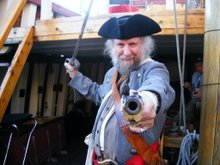
These books follow the adventures of Fin Button as she goes from being abandoned at an orphanage to becoming a legend.
The first part deals with Fin's life in the orphanage. She is a tom-boy in her late teens who hates the orphanage. She hopes to help build the new church. Instead she is assigned to help the old cook. He teaches her to cook and play the fiddle. When he dies she inherits his fiddle case which also contains a blunderbuss pistol named Betsy.
The Revolutionary War intrudes and Fin has to flee. She becomes a sailor and discovers that she loves the sea. As the war progresses her crew becomes privateers. It turns out that her captain and the old fiddler are connected. This leads to conflicts both with the British and her captain. By the end of the book Fin is voted captain.
In Fiddler's Green, Fin and her crew are offered a deal by Congress. They will be pardoned for past of offenses if they save a countess from the Barbary pirates. It soon becomes obvious that they have bitten off more than they can chew.
These books are readable and fairly well researched. The story drags a bit at the beginning but picks up when Fin goes to sea. Some of the plot twists are predictable - almost painfully so. This is mainly true in the first book. The second book is an improvement. Few of the plot twists in the second book are telegraphed.
These are not happy books. Most of Fin's companions die along the way which Fin blames herself for.
A few notes on the premise:
Women sailors disguised as men existed. There were even more women disguised as soldiers from the Revolution through the Civil War so Fin passing herself off as a young man is quite possible.
The book has several ships of the line taking part in the Revolution. I don't think the author realizes just how big and powerful these ships were or he would have used "sloop" or "frigate" instead of "ship of the line". This and Ben Franklin's use of "kilometers" are the biggest historic goofs that I noticed.
Fiddler's Green is a special heaven for sailors. The song is from the 20th century but the legend goes back at least to the 18th century.
The books are available through the official site and through Amazon. Both books are available in the Kindle format. Only the first one is available as a Nook book.
Tuesday, December 20, 2011

Tuesday, December 6, 2011
Neverland
So, what to make of Syfy's Neverland?
Obviously the movie was a prequel to Peter Pan. Not so obviously, the producers probably did not pay royalties so the production was a little strange.
The main characters were Peter (I don't think that we got his last name) and James Hook (who did not wear a hook and was never referred to as "Captain Hook", even after he took command of the pirates). Instead of being Blackbeard's quartermaster and a look-alike for King James, this Hook was a Victorian fencing master and thief. He did eventually pick up a red coat.
Instead of pixies and fairy dust, we had tree spirits and mineral dust.
Peter did learn to fly. Instead of whistling, he carried a tin whistle. Instead of green, he wore his London clothing. He did lose his shadow at the end but not in a Victorian nursery. In a nod to the book, Peter was cursed to lose his memory and be eternally innocent (that was his description in the book). It wore off.
Peter had a band of orphans with him but they were never called the Lost Boys.
Plus there were pirates, indians, and a giant, eight-legged crocodile (this was a SyFy production, after all). There was also a giant scorpion that could spin webs.
The pirates had a nice ship and looked ok (except for one who looked like a Jonny Depp impersonator). The pirates were led by a woman and was probably inspired by a couple of historic pirates.
The whole thing was a two-night, four hour (including ads) production. The problem is that they only had enough plot and special effects money for two hours so they padded it with a lot of talking followed by more talking.
Bob Hoskins reprized his role as Smee which he played in Hook, another production that ran too long. He was generally wasted as was Kiera Knightly as the telepathic voice of Tinkerbell.
The concept was good but the production was too serious. A lighter touch would have helped a lot.
When I first watched Hook, I ad a hard time rooting for Peter Pan. I knew that I would fit in better with the pirates. The same was true with Neverland.
Obviously the movie was a prequel to Peter Pan. Not so obviously, the producers probably did not pay royalties so the production was a little strange.
The main characters were Peter (I don't think that we got his last name) and James Hook (who did not wear a hook and was never referred to as "Captain Hook", even after he took command of the pirates). Instead of being Blackbeard's quartermaster and a look-alike for King James, this Hook was a Victorian fencing master and thief. He did eventually pick up a red coat.
Instead of pixies and fairy dust, we had tree spirits and mineral dust.
Peter did learn to fly. Instead of whistling, he carried a tin whistle. Instead of green, he wore his London clothing. He did lose his shadow at the end but not in a Victorian nursery. In a nod to the book, Peter was cursed to lose his memory and be eternally innocent (that was his description in the book). It wore off.
Peter had a band of orphans with him but they were never called the Lost Boys.
Plus there were pirates, indians, and a giant, eight-legged crocodile (this was a SyFy production, after all). There was also a giant scorpion that could spin webs.
The pirates had a nice ship and looked ok (except for one who looked like a Jonny Depp impersonator). The pirates were led by a woman and was probably inspired by a couple of historic pirates.
The whole thing was a two-night, four hour (including ads) production. The problem is that they only had enough plot and special effects money for two hours so they padded it with a lot of talking followed by more talking.
Bob Hoskins reprized his role as Smee which he played in Hook, another production that ran too long. He was generally wasted as was Kiera Knightly as the telepathic voice of Tinkerbell.
The concept was good but the production was too serious. A lighter touch would have helped a lot.
When I first watched Hook, I ad a hard time rooting for Peter Pan. I knew that I would fit in better with the pirates. The same was true with Neverland.
Wednesday, November 16, 2011
Damn You Mythbusters!!
I ran across a Cracked list of pirate myths and, sure enough, number 3 is that they wore eye patches so that they could see in dark holds. The justification for this was the Mythbusters pirate episode. The rest of the list wasn't very good either and I'm not going to bother linking to it. In fact, their lists aren't very well researched. In a list on real people who were hard to kill, they implied that Lt. Maynard's two sloops were bigger than Blackbeard's. Actually, Maynard's sloops were so small that they didn't have any cannon and only one of the sloops was involved in the actual fighting.
While it was nice that Mythbusters did a pirate episode, I suspect that they made up some of their pirate myths. Using rum for washing? The one real pirate myth, that splinters were more dangerous than a cannon ball, they got wrong. Their tests showed a cannon ball cleanly penetrating a hull with minimal splinters. This contradicts centuries of actual experience. What happened? They shot their cannon ball at close range with a full charge. If they had backed off a few hundred yards or used less powder then the ball would have made more splinters (the British have actually tested this).
As for eye patches, I never heard of anyone wearing an eye patch to preserve his night vision before a fantasy novel written in 2000 and that did not have any pirates. A soldier would go into a seedy tavern and flash some money while wearing an eye patch. He would go back into the night and remove the eye patch. Then he and his companions would seize and would-be robbers and confiscate their money.
I can imagine this making its way to the Mythbusters as a pirate myth and they did not spend any time checking the historic accuracy of the myths they tested. They just went with them.
Then their fans across the country accepted it as fact.
Damn you Mythbusters!
While it was nice that Mythbusters did a pirate episode, I suspect that they made up some of their pirate myths. Using rum for washing? The one real pirate myth, that splinters were more dangerous than a cannon ball, they got wrong. Their tests showed a cannon ball cleanly penetrating a hull with minimal splinters. This contradicts centuries of actual experience. What happened? They shot their cannon ball at close range with a full charge. If they had backed off a few hundred yards or used less powder then the ball would have made more splinters (the British have actually tested this).
As for eye patches, I never heard of anyone wearing an eye patch to preserve his night vision before a fantasy novel written in 2000 and that did not have any pirates. A soldier would go into a seedy tavern and flash some money while wearing an eye patch. He would go back into the night and remove the eye patch. Then he and his companions would seize and would-be robbers and confiscate their money.
I can imagine this making its way to the Mythbusters as a pirate myth and they did not spend any time checking the historic accuracy of the myths they tested. They just went with them.
Then their fans across the country accepted it as fact.
Damn you Mythbusters!
Thursday, October 27, 2011
Blackbeard's Cannon Salvaged
A massive cannon was salvaged from what is believed to be the wreck of Queen Anne's Revenge.
This was actually the 13th cannon that has been recovered and it will take five years of conservation work before the cannon is ready for public viewing. One cannon from Queen Anne's Revenge is already on display at the North Caroline Maritime Museum in Beaufort.
This was actually the 13th cannon that has been recovered and it will take five years of conservation work before the cannon is ready for public viewing. One cannon from Queen Anne's Revenge is already on display at the North Caroline Maritime Museum in Beaufort.
Wednesday, September 28, 2011
Review: Pirate Hunter of the Caribbean: The Adventurous Life of Captain Woodes Rogers
Officially this is a biography of the twice-governor of the Bahamas and the man who ended piracy in the Caribbean. While Woodes Rogers had an eventful life, details of it are sketchy so the book is padded with a lot of general information on piracy. It also contains a mini-biography of Alexander Selkirk who was an inspiration for Robinson Crusoe.
The book was written by David Cordingly who has written other major works on piracy such as Under the Black Flag and his familiarity with piracy shows.
While Rogers was twice governor of the Bahamas, this was not his major achievement. He was one of the first captains to circumnavigate the world and his exploits doing this and attacking the Spanish in the Pacific are more exciting than a Pirates of the Caribbean novel.
In addition to Rogers and Selkirk, the book follows other pirates to their end including Blackbeard and Calico Jack Rackham. Several battles are described in detail showing just how audacious the pirates and privateers were.
The book was written by David Cordingly who has written other major works on piracy such as Under the Black Flag and his familiarity with piracy shows.
While Rogers was twice governor of the Bahamas, this was not his major achievement. He was one of the first captains to circumnavigate the world and his exploits doing this and attacking the Spanish in the Pacific are more exciting than a Pirates of the Caribbean novel.
In addition to Rogers and Selkirk, the book follows other pirates to their end including Blackbeard and Calico Jack Rackham. Several battles are described in detail showing just how audacious the pirates and privateers were.
Monday, September 19, 2011
Talking Like a Pirate on the Santa Maria
We held our annual Talk Like a Pirate Weekend on the Santa Maria September 17 & 18. The event is held on the closest weekend to Talk Like a Pirate Day.
Gas prices, health problems, and competing festivals kept the number of pirates down but we still had a decent turn-out. Counting ship staff members who put on costumes, we had nearly twenty pirates.
This is an educational event and the pirates worked hard. We had different stations where people were presenting something relating to pirates. This included Mission's pirate surgeon display, a gaming table, and cooking. I brought my new cannon and ran visitors through cannon drills. Michael made a hammock. There was also a table where kids could get certificates making them part of the pirate crew. These were hand-lettered and had wax seals.
We had to scale back the battle. Sometimes we have had enough pirates to fill three boats. This time we only used one boat with no effort to actually board the ship. I don't think that the visitors noticed the difference.
Attendance was not as good as last year but it was still a very good weekend taking in just under $2,000 for the weekend.
Disney contacted us and donated hundreds of posters and certificates for two Pirates of the Caribbean: On Stranger Tides DVD so every family got a posted and a chance to win a DVD.
Gas prices, health problems, and competing festivals kept the number of pirates down but we still had a decent turn-out. Counting ship staff members who put on costumes, we had nearly twenty pirates.
This is an educational event and the pirates worked hard. We had different stations where people were presenting something relating to pirates. This included Mission's pirate surgeon display, a gaming table, and cooking. I brought my new cannon and ran visitors through cannon drills. Michael made a hammock. There was also a table where kids could get certificates making them part of the pirate crew. These were hand-lettered and had wax seals.
We had to scale back the battle. Sometimes we have had enough pirates to fill three boats. This time we only used one boat with no effort to actually board the ship. I don't think that the visitors noticed the difference.
Attendance was not as good as last year but it was still a very good weekend taking in just under $2,000 for the weekend.
Disney contacted us and donated hundreds of posters and certificates for two Pirates of the Caribbean: On Stranger Tides DVD so every family got a posted and a chance to win a DVD.
Friday, September 9, 2011
Small Boats
I've been reading Pirate Hunter of the Caribbean: The Adventurous Life of Captain Woodes Rogers and I was struck by the use of small, open boats. In several cases pirates left their ships behind and attacked ships or even cities from boats.
Attacking cities always meant landing which usually meant using boats. It was common for pirates to land some distance from a city and attack it from land. But other times they would land and attack.
Fighting a ship from a boat seems foolish. One good hit from a cannon and the boat is gone. On the pirate's side, they could only carry small arms.
Surprisingly this was enough. In one case three dug-outs carrying sixty some pirates met three warships with over two hundred sailors and soldiers. The pirates won, driving off one ship and forcing the other two to surrender.
Boats offer a few advantages over ships. Boats were faster and could move against the wind. In the case above, the pirates shot the helmsman of one ship and it turned into the wind and stopped - what is known as being "in irons". They continued to shoot anyone who tried to take the tiller. Since cannons are mainly aimed by turning the ship, that rendered the cannon useless.
The pirates were better shots than the Spanish. After the battle ended, the Spanish tallied their dead and wounded. Only a half-dozen were completely unharmed.
I read a different account in in Exquemelin where he describes a small ship taking a much larger one. In this case the Spanish captain saw the pirates but dismissed them as being too inferior a force to threaten his ship. After dark the pirates used a boat to board the Spanish ship, took the captain hostage, and forced the surrender of the ship.
Attacking cities always meant landing which usually meant using boats. It was common for pirates to land some distance from a city and attack it from land. But other times they would land and attack.
Fighting a ship from a boat seems foolish. One good hit from a cannon and the boat is gone. On the pirate's side, they could only carry small arms.
Surprisingly this was enough. In one case three dug-outs carrying sixty some pirates met three warships with over two hundred sailors and soldiers. The pirates won, driving off one ship and forcing the other two to surrender.
Boats offer a few advantages over ships. Boats were faster and could move against the wind. In the case above, the pirates shot the helmsman of one ship and it turned into the wind and stopped - what is known as being "in irons". They continued to shoot anyone who tried to take the tiller. Since cannons are mainly aimed by turning the ship, that rendered the cannon useless.
The pirates were better shots than the Spanish. After the battle ended, the Spanish tallied their dead and wounded. Only a half-dozen were completely unharmed.
I read a different account in in Exquemelin where he describes a small ship taking a much larger one. In this case the Spanish captain saw the pirates but dismissed them as being too inferior a force to threaten his ship. After dark the pirates used a boat to board the Spanish ship, took the captain hostage, and forced the surrender of the ship.
Subscribe to:
Posts (Atom)