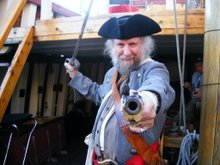
Today is the anniversary of Francis Drake's knighting, 431 years ago. Wires has a recap of Drake's voyage that earned him the honor.
Technically, Drake was a privateer instead of a pirate although the Spanish wanted him hung as a pirate. It was not circumnavigating the Earth that won Drake his knighthood, it was the huge return he brought on Queen Elizabeth's investment. Drake's hold not only held Spanish gold, it also held tons of spices which were worth their weight in gold.
Wednesday, April 4, 2012

Wednesday, March 14, 2012
Pilgrims and Pirates
Years ago, when Disney was still designing Epcot, they asked Plimoth Plantation for some costume information on the Pilgrims. After looking at the material, they said, "We can't use that. They look like pirates!" (This was probably back when Plimoth dressed all of the men in bucket-top boots).
I ran into the opposite at Searle's Raid this year. We were on the trolly, headed for the beginning of the battle and someone thought that we were a bunch of Pilgrims.
I ran into the opposite at Searle's Raid this year. We were on the trolly, headed for the beginning of the battle and someone thought that we were a bunch of Pilgrims.
Tuesday, March 6, 2012
Searle's 2012
The 2012 reenactment of Searle's Raid on Saint Augusting was held March 2-3. This is an expanding event. The organizers said that they had ten more participants than last year.
Searle's isn't quite a pirate event. Searle was a privateer and one of Henry Morgan's lieutenants. This event predates the skull and crossbones and most other symbols of the Golden Age or Piracy.
Saint Augustine in the 1660s was hardly a rich city. Florida had no gold or silver so there was little of value passing through. On the other hand, it was isolated since it was Spain's most northern outpost. At the time it was only guarded by a wooden stockade.
Searle's men spent two days taking the town and besieging the fort. By that time they had a number of the town's women held hostage. Eventually the town paid Searle in cattle and flour to leave.
The reenactment started Friday evening with a parade through St. George Street, the oldest street in the city. There was some exercise of arms as the Spanish showed that they were ready for the English invaders (actually, on Friday everyone was Spanish). Afterward we had dinner in the 18th century taverna (home to the best sangria in St. Augustine).
The troops were camped on the grounds of the Fountain of Youth which was the site of the original colony for its first year or so. During Saturday the troops drilled with pikes and practiced firing.
Around 4:30 a trolly took the combatants to the town. The English retired a couple of blocks away until the appointed time (our permit was for 5-6 pm). The initial battle took place in Cathedral Square. The Spanish broke and retired in good order through St. George Street, pursued by the English. There was a final battle at the fort (in a small field beside the old cemetery). The whole thing took most of an hour with designated firing positions along the way.
There were 60+ participants including musketeers, pikemen, skirmishers with swords, officers, drummers, ensigns, and crew for a couple of small cannon. This may not be large by the standard of other periods but it is the biggest 17th century battle that I know of.
The weather was good with highs in the 80s. It was windy on Saturday ahead of a major storm front. Several people had to chaise their hats because of the wind. The front came through quickly overnight and the weather was clear for people to break camp on Sunday.
Last year was my first year. This time I brought my wife. She was properly impressed and will be returning. Maybe we can bring some more people next year.
Searle's isn't quite a pirate event. Searle was a privateer and one of Henry Morgan's lieutenants. This event predates the skull and crossbones and most other symbols of the Golden Age or Piracy.
Saint Augustine in the 1660s was hardly a rich city. Florida had no gold or silver so there was little of value passing through. On the other hand, it was isolated since it was Spain's most northern outpost. At the time it was only guarded by a wooden stockade.
Searle's men spent two days taking the town and besieging the fort. By that time they had a number of the town's women held hostage. Eventually the town paid Searle in cattle and flour to leave.
The reenactment started Friday evening with a parade through St. George Street, the oldest street in the city. There was some exercise of arms as the Spanish showed that they were ready for the English invaders (actually, on Friday everyone was Spanish). Afterward we had dinner in the 18th century taverna (home to the best sangria in St. Augustine).
The troops were camped on the grounds of the Fountain of Youth which was the site of the original colony for its first year or so. During Saturday the troops drilled with pikes and practiced firing.
Around 4:30 a trolly took the combatants to the town. The English retired a couple of blocks away until the appointed time (our permit was for 5-6 pm). The initial battle took place in Cathedral Square. The Spanish broke and retired in good order through St. George Street, pursued by the English. There was a final battle at the fort (in a small field beside the old cemetery). The whole thing took most of an hour with designated firing positions along the way.
There were 60+ participants including musketeers, pikemen, skirmishers with swords, officers, drummers, ensigns, and crew for a couple of small cannon. This may not be large by the standard of other periods but it is the biggest 17th century battle that I know of.
The weather was good with highs in the 80s. It was windy on Saturday ahead of a major storm front. Several people had to chaise their hats because of the wind. The front came through quickly overnight and the weather was clear for people to break camp on Sunday.
Last year was my first year. This time I brought my wife. She was properly impressed and will be returning. Maybe we can bring some more people next year.
Wednesday, February 29, 2012
Pirates of Penzance
Today is the 29th of February, Leap Day. That is an important plot point in Pirates of Penznace. The lead character, Frederic was supposed to be apprenticed to a "pilot" until 21 but his nurse was hard of hearing and apprenticed him to some pirates. To make things worse, she apprenticed him until his 21st birthday. Frederic was born on February 29th so, even though he had been born 21 years before, his 21st birthday was still decades away.
The opera begins on Frederic's birthday which means that it is the end of February. As soon as he goes ashore, he sees a group of the Major-General's daughters out for a swim.
In February!
They grow them tough in Penzance.
Gilbert and Sullivan probably chose Penzance for its alliteration. It is a port on the far south-western tip of Cornwall. In the 19th century it was a seaside resort but in previous centuries its isolation had made it a frequent target for "Turkish pirates" - the Corsairs from the Barbary Coast. It was also sacked and burned by the Spanish in 1595.
The opera begins on Frederic's birthday which means that it is the end of February. As soon as he goes ashore, he sees a group of the Major-General's daughters out for a swim.
In February!
They grow them tough in Penzance.
Gilbert and Sullivan probably chose Penzance for its alliteration. It is a port on the far south-western tip of Cornwall. In the 19th century it was a seaside resort but in previous centuries its isolation had made it a frequent target for "Turkish pirates" - the Corsairs from the Barbary Coast. It was also sacked and burned by the Spanish in 1595.
Monday, January 9, 2012
The Adventures of Tintin
The Adventures of Tintin is an adventure movie set in the 1930s but it contains a rousing back story involving pirates.
The movie itself is Steven Spielburg's first animated movie and his most entertaining movie since Raiders of the Lost Ark.
According to IMDB, Spielburg has wanted to do a movie based on the Belgium comic strip character, Tintin, since the 1980s. A few years ago he called Steve Jackson to see if Jackson's Weta special effects unit was available to do a live-action version of Tintin. Jackson convinced Spielburg that the movie should be done as an animated movie instead of live-action.
The result is a gorgeously animated movie that never seems to hit the Uncanny Valley. Among other things it features an amazing chase after the clues to the pirate treasure. Most of the chase was done as a continuous take with the camera constantly shifting as it moved from one character to another.
Pirate fans will be glad to know that a good bit of the action takes place at sea - either on a 1930s freighter or on the 17thc century Unicorn.
I suspect that Spielburg had more fun making this movie than he has had in years.
Tintin is not well-known in the US and the movie did not do well here but it was a huge hit overseas and grossed over $300 million. A sequel is planned with Jackson directing and Spielburg producing.
The movie itself is Steven Spielburg's first animated movie and his most entertaining movie since Raiders of the Lost Ark.
According to IMDB, Spielburg has wanted to do a movie based on the Belgium comic strip character, Tintin, since the 1980s. A few years ago he called Steve Jackson to see if Jackson's Weta special effects unit was available to do a live-action version of Tintin. Jackson convinced Spielburg that the movie should be done as an animated movie instead of live-action.
The result is a gorgeously animated movie that never seems to hit the Uncanny Valley. Among other things it features an amazing chase after the clues to the pirate treasure. Most of the chase was done as a continuous take with the camera constantly shifting as it moved from one character to another.
Pirate fans will be glad to know that a good bit of the action takes place at sea - either on a 1930s freighter or on the 17thc century Unicorn.
I suspect that Spielburg had more fun making this movie than he has had in years.
Tintin is not well-known in the US and the movie did not do well here but it was a huge hit overseas and grossed over $300 million. A sequel is planned with Jackson directing and Spielburg producing.
Tuesday, December 20, 2011
Book review: Fiddler's Gun/Fiddler's Green by A. S. Peterson
These books follow the adventures of Fin Button as she goes from being abandoned at an orphanage to becoming a legend.
The first part deals with Fin's life in the orphanage. She is a tom-boy in her late teens who hates the orphanage. She hopes to help build the new church. Instead she is assigned to help the old cook. He teaches her to cook and play the fiddle. When he dies she inherits his fiddle case which also contains a blunderbuss pistol named Betsy.
The Revolutionary War intrudes and Fin has to flee. She becomes a sailor and discovers that she loves the sea. As the war progresses her crew becomes privateers. It turns out that her captain and the old fiddler are connected. This leads to conflicts both with the British and her captain. By the end of the book Fin is voted captain.
In Fiddler's Green, Fin and her crew are offered a deal by Congress. They will be pardoned for past of offenses if they save a countess from the Barbary pirates. It soon becomes obvious that they have bitten off more than they can chew.
These books are readable and fairly well researched. The story drags a bit at the beginning but picks up when Fin goes to sea. Some of the plot twists are predictable - almost painfully so. This is mainly true in the first book. The second book is an improvement. Few of the plot twists in the second book are telegraphed.
These are not happy books. Most of Fin's companions die along the way which Fin blames herself for.
A few notes on the premise:
Women sailors disguised as men existed. There were even more women disguised as soldiers from the Revolution through the Civil War so Fin passing herself off as a young man is quite possible.
The book has several ships of the line taking part in the Revolution. I don't think the author realizes just how big and powerful these ships were or he would have used "sloop" or "frigate" instead of "ship of the line". This and Ben Franklin's use of "kilometers" are the biggest historic goofs that I noticed.
Fiddler's Green is a special heaven for sailors. The song is from the 20th century but the legend goes back at least to the 18th century.
The books are available through the official site and through Amazon. Both books are available in the Kindle format. Only the first one is available as a Nook book.
The first part deals with Fin's life in the orphanage. She is a tom-boy in her late teens who hates the orphanage. She hopes to help build the new church. Instead she is assigned to help the old cook. He teaches her to cook and play the fiddle. When he dies she inherits his fiddle case which also contains a blunderbuss pistol named Betsy.
The Revolutionary War intrudes and Fin has to flee. She becomes a sailor and discovers that she loves the sea. As the war progresses her crew becomes privateers. It turns out that her captain and the old fiddler are connected. This leads to conflicts both with the British and her captain. By the end of the book Fin is voted captain.
In Fiddler's Green, Fin and her crew are offered a deal by Congress. They will be pardoned for past of offenses if they save a countess from the Barbary pirates. It soon becomes obvious that they have bitten off more than they can chew.
These books are readable and fairly well researched. The story drags a bit at the beginning but picks up when Fin goes to sea. Some of the plot twists are predictable - almost painfully so. This is mainly true in the first book. The second book is an improvement. Few of the plot twists in the second book are telegraphed.
These are not happy books. Most of Fin's companions die along the way which Fin blames herself for.
A few notes on the premise:
Women sailors disguised as men existed. There were even more women disguised as soldiers from the Revolution through the Civil War so Fin passing herself off as a young man is quite possible.
The book has several ships of the line taking part in the Revolution. I don't think the author realizes just how big and powerful these ships were or he would have used "sloop" or "frigate" instead of "ship of the line". This and Ben Franklin's use of "kilometers" are the biggest historic goofs that I noticed.
Fiddler's Green is a special heaven for sailors. The song is from the 20th century but the legend goes back at least to the 18th century.
The books are available through the official site and through Amazon. Both books are available in the Kindle format. Only the first one is available as a Nook book.
Tuesday, December 6, 2011
Neverland
So, what to make of Syfy's Neverland?
Obviously the movie was a prequel to Peter Pan. Not so obviously, the producers probably did not pay royalties so the production was a little strange.
The main characters were Peter (I don't think that we got his last name) and James Hook (who did not wear a hook and was never referred to as "Captain Hook", even after he took command of the pirates). Instead of being Blackbeard's quartermaster and a look-alike for King James, this Hook was a Victorian fencing master and thief. He did eventually pick up a red coat.
Instead of pixies and fairy dust, we had tree spirits and mineral dust.
Peter did learn to fly. Instead of whistling, he carried a tin whistle. Instead of green, he wore his London clothing. He did lose his shadow at the end but not in a Victorian nursery. In a nod to the book, Peter was cursed to lose his memory and be eternally innocent (that was his description in the book). It wore off.
Peter had a band of orphans with him but they were never called the Lost Boys.
Plus there were pirates, indians, and a giant, eight-legged crocodile (this was a SyFy production, after all). There was also a giant scorpion that could spin webs.
The pirates had a nice ship and looked ok (except for one who looked like a Jonny Depp impersonator). The pirates were led by a woman and was probably inspired by a couple of historic pirates.
The whole thing was a two-night, four hour (including ads) production. The problem is that they only had enough plot and special effects money for two hours so they padded it with a lot of talking followed by more talking.
Bob Hoskins reprized his role as Smee which he played in Hook, another production that ran too long. He was generally wasted as was Kiera Knightly as the telepathic voice of Tinkerbell.
The concept was good but the production was too serious. A lighter touch would have helped a lot.
When I first watched Hook, I ad a hard time rooting for Peter Pan. I knew that I would fit in better with the pirates. The same was true with Neverland.
Obviously the movie was a prequel to Peter Pan. Not so obviously, the producers probably did not pay royalties so the production was a little strange.
The main characters were Peter (I don't think that we got his last name) and James Hook (who did not wear a hook and was never referred to as "Captain Hook", even after he took command of the pirates). Instead of being Blackbeard's quartermaster and a look-alike for King James, this Hook was a Victorian fencing master and thief. He did eventually pick up a red coat.
Instead of pixies and fairy dust, we had tree spirits and mineral dust.
Peter did learn to fly. Instead of whistling, he carried a tin whistle. Instead of green, he wore his London clothing. He did lose his shadow at the end but not in a Victorian nursery. In a nod to the book, Peter was cursed to lose his memory and be eternally innocent (that was his description in the book). It wore off.
Peter had a band of orphans with him but they were never called the Lost Boys.
Plus there were pirates, indians, and a giant, eight-legged crocodile (this was a SyFy production, after all). There was also a giant scorpion that could spin webs.
The pirates had a nice ship and looked ok (except for one who looked like a Jonny Depp impersonator). The pirates were led by a woman and was probably inspired by a couple of historic pirates.
The whole thing was a two-night, four hour (including ads) production. The problem is that they only had enough plot and special effects money for two hours so they padded it with a lot of talking followed by more talking.
Bob Hoskins reprized his role as Smee which he played in Hook, another production that ran too long. He was generally wasted as was Kiera Knightly as the telepathic voice of Tinkerbell.
The concept was good but the production was too serious. A lighter touch would have helped a lot.
When I first watched Hook, I ad a hard time rooting for Peter Pan. I knew that I would fit in better with the pirates. The same was true with Neverland.
Subscribe to:
Posts (Atom)