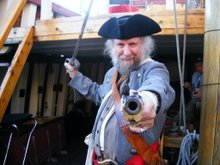
Nothing says pirate event like standing on a sandy island under a palm tree, watching two tall ships firing cannons at each other on a warm night in December.
I was in Key West for the Fort Zachary Taylor Pirate Fest, part of the larger Pirates in Paradise festival.
The larger festival is purely "pirate" (or polyester pirate as some people call them). It included Captain Hook and a pirate Santa Clause. The part of it in the fort was focused much more on history although there were still some ren fair pirates.
The historical pirates had our own camp, officially the "careening camp". The idea was that we were camping on an island while our ship was being careened (this involved beaching the ship and scraping the growths off of the sides for extra speed). The festival continued into the fort with a couple of dozen vendors. These ranged from the same suttlers who set up at any historic event to a Utilikilt vendor (modern kilts).
The festival ran for four days. Each day had an attack on the fort. The first two days the pirates attacked unsuccessfully. On the third day they succeeded in capturing the fort. On the fourth day the British tried to recover the fort but failed.
The pirates were armed with small arms, mainly pistols and blunderbusses, and cannon. The British had more muskets and rifles and their own cannon. The pirates were aided by the tall ship, the Wolf which also fired on the fort.
There were three different two-masted ships that were part of the festival. At sunset each day they sailed past the camp, often firing on each other. There was also some firing from the walls at sunset most evenings.
Key West had a holiday parade on Saturday night and most of the pirates joined in that. I took a cab with a couple of others. We ran into a few more pirates near the start of the parade and decided to wait there. By the time the pirate unit went by we had around 20. Other pirates kept joining. I would guess that there were around 100 by the end of the parade.
On Sunday night the fort held a pig roast for the participants. The was accompanied by a "dead man's chest" auction to benefit the site and a show of some of the photographs that had been taken during the festival.
Wednesday, December 17, 2008

Tuesday, December 2, 2008
Shallops
A shallop (from the French chaloupe en fagot) was a small boat, larger than a ship's boat. The prow and stern were rounded. The stern was shaped like the bow except for the addition of a rudder and tiller. They could be disassembled into two or more pieces for easy transport. Both the Jamestown and Plymouth colonies had them. John Smith spent months on one mapping the Chesapeake. The one that the Pilgrims had was their chief means of transportation by water for some time. They were mainly coastal vessels. Larger ones might have a deck or half-deck. They were good craft for exploration since they were shallow-drafted and could be sailed or rowed.
These were not ideal pirate boats by any means but pirates tended to make due with whatever was at hand. Morgan probably had a shallop or two with him on some of his raids.
I've been looking at modern examples to study their rigging. They have the same type of sails as my Whitehall boat - a large sprit-rigged sail and a jib.
There are at least five modern shallops. The oldest was designed for Plimoth Plantation by William Baker who designed most of the 17th century reproductions built in the 1950s through the 1970s. There are no paintings or woodcuts that show shallops by name so he had to decide which type of boat to use. He went with a style that is common in Dutch paintings. This had the sprit-rigged sail and lee-boards rather than a keel.
The Pilgrim shallop was built to meet the Mayflower II when it arrived in America in 1957. Baker's plans called for it to be lapstrake (overlapped planks) but the builders refused, insisting that this was a sign of inferior workmanship. I've been on this shallop a couple of times, once for an afternoon sail and once for three days of filming a National Geographic video on John Smith's voyage.
The John Howland Society along with Plimoth Plantation built a larger shallop based on a description from William Bradford's History of Plimoth Plantation. There is an account here including the reasoning behind the design and a description of the launch.
Three other shallops were built for Jamestown's 400th anniversary. You can see them all here and here. (Note that one of these has a wineglass transom.) Here are pictures of one of them being built.
Here is a PDF document with a lot of information on shallops including naming the diffierent parts. Pirates who want to know more about ships should study this. This shallop was designed from the beginning to be broken down into two pieces. Note that each half can float on its own. The halves are kept together with special pieces from the keel and rails.
Here is a archaeological dig of an original late-17th century shallop.
There are numerous images of shallops on Google Image.
These were not ideal pirate boats by any means but pirates tended to make due with whatever was at hand. Morgan probably had a shallop or two with him on some of his raids.
I've been looking at modern examples to study their rigging. They have the same type of sails as my Whitehall boat - a large sprit-rigged sail and a jib.
There are at least five modern shallops. The oldest was designed for Plimoth Plantation by William Baker who designed most of the 17th century reproductions built in the 1950s through the 1970s. There are no paintings or woodcuts that show shallops by name so he had to decide which type of boat to use. He went with a style that is common in Dutch paintings. This had the sprit-rigged sail and lee-boards rather than a keel.
The Pilgrim shallop was built to meet the Mayflower II when it arrived in America in 1957. Baker's plans called for it to be lapstrake (overlapped planks) but the builders refused, insisting that this was a sign of inferior workmanship. I've been on this shallop a couple of times, once for an afternoon sail and once for three days of filming a National Geographic video on John Smith's voyage.
The John Howland Society along with Plimoth Plantation built a larger shallop based on a description from William Bradford's History of Plimoth Plantation. There is an account here including the reasoning behind the design and a description of the launch.
Three other shallops were built for Jamestown's 400th anniversary. You can see them all here and here. (Note that one of these has a wineglass transom.) Here are pictures of one of them being built.
Here is a PDF document with a lot of information on shallops including naming the diffierent parts. Pirates who want to know more about ships should study this. This shallop was designed from the beginning to be broken down into two pieces. Note that each half can float on its own. The halves are kept together with special pieces from the keel and rails.
Here is a archaeological dig of an original late-17th century shallop.
There are numerous images of shallops on Google Image.
Thursday, November 20, 2008
Live Piracy Map
This blob isn't about modern piracy but this is still pretty cool - a Google map showing all international pirate activity for the past several months.
Wednesday, November 19, 2008

Friday, November 14, 2008
Spider Catcher
I'm not the only pirate to buy a Whitehall. Here is one on the West Coast who decided to use a Whitehall as a Spider Catcher. Basically this was a small, lightly armed boat used to catch and board larger ships. They were mainly used during the Revolutionary War.
His Whitehall is a bit small for this. Mine is a couple of feet longer and right about at the lower end of these boats. I don't have a small cannon but I do have swivel guns in two sizes which is probably more appropriate (and a lot more practical).
His Whitehall is a bit small for this. Mine is a couple of feet longer and right about at the lower end of these boats. I don't have a small cannon but I do have swivel guns in two sizes which is probably more appropriate (and a lot more practical).
Tuesday, November 11, 2008
Crusoe and Compasses
This is nitpicking but something bothers me about the last episode of Crusoe (besides the issue of slavery which I already blogged about).
Early in the episode Crusoe and Friday discover a damaged boat. It has an occupant who has a compass in his pocket. In the process of repairing the boat, the compass drops into a small fire. They pull it out. The wooden box is just a bit singed but Crusoe says that the needle has melted.
Really? The elements of this compass are a round wooden box, a piece of glass, a cardboard card, a brass spike to hold the needle, and the needle itself. The needle is iron and iron has the highest melting point of any of these ingredients. In fact, you could leave it in the fire until it burned out and fish the needle from the ashes unharmed (although heating can affect magnetism).
Crusoe and Friday borrow (meaning stealing) a compass from some mutineers. This one is similar except it is larger and housed in a brass case. At the end of the episode Crusoe pulls the compass from his boot and opens it showing that it is broken. Discouraged, he throws it into the sea.
Huh? The glass keeps the needle from slipping off but otherwise is unimportant. The needle should have been fine. He should have been able to have picked the broken glass out of the compass and still navigated with it.
Of course, if that happened the show would have ended on its 4th episode which isn't what the scriptwriters planned. On the other hand, given the ratings, the show might be in for a short stay, anyway.
Early in the episode Crusoe and Friday discover a damaged boat. It has an occupant who has a compass in his pocket. In the process of repairing the boat, the compass drops into a small fire. They pull it out. The wooden box is just a bit singed but Crusoe says that the needle has melted.
Really? The elements of this compass are a round wooden box, a piece of glass, a cardboard card, a brass spike to hold the needle, and the needle itself. The needle is iron and iron has the highest melting point of any of these ingredients. In fact, you could leave it in the fire until it burned out and fish the needle from the ashes unharmed (although heating can affect magnetism).
Crusoe and Friday borrow (meaning stealing) a compass from some mutineers. This one is similar except it is larger and housed in a brass case. At the end of the episode Crusoe pulls the compass from his boot and opens it showing that it is broken. Discouraged, he throws it into the sea.
Huh? The glass keeps the needle from slipping off but otherwise is unimportant. The needle should have been fine. He should have been able to have picked the broken glass out of the compass and still navigated with it.
Of course, if that happened the show would have ended on its 4th episode which isn't what the scriptwriters planned. On the other hand, given the ratings, the show might be in for a short stay, anyway.
Monday, November 10, 2008
Slavery in the GAoP
A recent episode of Crusoe involved Caruso and Friday finding a damaged boat and a compass. They repaired the boat but Friday seemed reluctant to leave the island. Eventually he admitted that he was worried about slavery, "Slaves in your country don't look like me, they look like you."
The practice of using African slaves in America has given a false impression of slavery in the 17th and 18th century. It was far more universal than just Europeans enslaving Africans. It also has some links with piracy (at least literary piracy).
First, at the same time that Europeans were obtaining slaves from Africa (most often buying Africans who had already been enslaved by fellow Africans), the corsairs of northern Africa were raiding European countries including England for people they could sell as slaves in the Mediterranean. In fact, slavery was not legal in England although it was being introduced to the English colonies about that time. Earlier in the 17th century Africans sold in America were treated as indentured servants but the growing number of free blacks alarmed the colonists and they decided to keep the Africans in permanent bondage.
Now for the literary angle - the last couple of episodes of Crusoe have included flashbacks to a judge during the Monouth Rebellion. This ties in with Rafael Sabatin's Captain Blood. The book starts with Peter Blood, a retired soldier who became a doctor helping a wounded friend. It seems that the friend was part of the Monmouth rebellion and judged a traitor. For helping him, Blood was also convicted of treason. Rather than being executed, they were shipped to the Caribbean and sold as slaves. They eventually escaped and took to piracy until James II was replaced by William and Mary and they were pardoned.
While European enslaving of Africans was not the only slavery going on, it was the most systematic with special ships built to transport slaves. These made excellent pirate ships since they were large, fast, and well-armed. The Whydah was a former slave ship. In another fictional tie-in, Jack Sparrow's Black Pearl was also built to be a slaver.
It is commonly assumed that after pirates captured a slave ship they would free the slaves. This is incorrect. While many pirates were former slaves, pirates seldom had any compunction about treating slaves as plunder and selling them at the closest market.
To really complicate the issue, in the novel, Crusoe was both a slave himself and a slave owner at different points in his life prior to eing shipwrecked.
The practice of using African slaves in America has given a false impression of slavery in the 17th and 18th century. It was far more universal than just Europeans enslaving Africans. It also has some links with piracy (at least literary piracy).
First, at the same time that Europeans were obtaining slaves from Africa (most often buying Africans who had already been enslaved by fellow Africans), the corsairs of northern Africa were raiding European countries including England for people they could sell as slaves in the Mediterranean. In fact, slavery was not legal in England although it was being introduced to the English colonies about that time. Earlier in the 17th century Africans sold in America were treated as indentured servants but the growing number of free blacks alarmed the colonists and they decided to keep the Africans in permanent bondage.
Now for the literary angle - the last couple of episodes of Crusoe have included flashbacks to a judge during the Monouth Rebellion. This ties in with Rafael Sabatin's Captain Blood. The book starts with Peter Blood, a retired soldier who became a doctor helping a wounded friend. It seems that the friend was part of the Monmouth rebellion and judged a traitor. For helping him, Blood was also convicted of treason. Rather than being executed, they were shipped to the Caribbean and sold as slaves. They eventually escaped and took to piracy until James II was replaced by William and Mary and they were pardoned.
While European enslaving of Africans was not the only slavery going on, it was the most systematic with special ships built to transport slaves. These made excellent pirate ships since they were large, fast, and well-armed. The Whydah was a former slave ship. In another fictional tie-in, Jack Sparrow's Black Pearl was also built to be a slaver.
It is commonly assumed that after pirates captured a slave ship they would free the slaves. This is incorrect. While many pirates were former slaves, pirates seldom had any compunction about treating slaves as plunder and selling them at the closest market.
To really complicate the issue, in the novel, Crusoe was both a slave himself and a slave owner at different points in his life prior to eing shipwrecked.
Subscribe to:
Posts (Atom)