We've taken the Whitehall out the last couple of Saturdays. Last week there was no wind at all so I tried the rowing seat. It worked quite well with my legs doing most of the work. I rowed a mile and a half to two miles and I never had to breath hard.
This week there was some wind so I finally got to try the sails.
Technically it was what is know as light wind. I think the wind was in the 5-10 mph range. This is a good windspeed for trying sailing since there is enough wind to get you moving but not enough to cause problems.
The Whitehall sails really well. I was pretty much able to go anywhere I wanted. There were a couple of times that the wind died and we did one tack as the wind was dying. I was able to use the job to get us out of that.
When the wind was blowing from the side or slightly ahead of us the boat really sped along. A few times I was overtaking modern sailboats going the same direction.
I was cautious. I could have gotten more speed out of her but I didn't want to get the side too close to the water so I slacked off sail a bit. We still had to lean into the wind.
I was especially proud that I was able to pull right up to the dock and grab a cleat with my boathook.
I tried it with the centerboard up and down. I couldn't tell the difference. The Whitehall is designed to move in a straight line so the centerboard may be superfluous.
I ordered a couple of new cleats for the rail. I had been using a pair of cleats meant for controlling the job when single-handing. These are rather small and are forward of where I wanted them. I found some reasonably-priced bronze cleats on-line and got them in time to install them Friday. They helped a lot in controlling the boat at a dock. I really wonder why no one ever installed a pair before?
A couple of improvements I need to make before we go to the Hampton Blackbeard Festival next week - I improvised a brail line for taking in the sail in a hurry. I'm going to replace it with one that is longer and a different type of rope. I want to be able to identify it easily since this is what we will use if we need to take in the sail in an emergency. Along the same lines, I am going to use a small carabiner to attach the boom to traveler. I want to be able to detach this quickly in an emergency. Taking the traveler line free takes too long. Yesterday I had to use a marlinspike to get the stopper knot out. With the carabiner I can leave the line permanently attached.
I need some way to be able to tie off the tiller. I used the long one and it kept swinging wide. At dock it kept getting caught on the dock. When sailing it would swing out of reach if I took my hand off of it to pump out the boat. Maybe I can rig up something with the new cleats.
Sunday, May 31, 2009

Tuesday, May 12, 2009
Pirates on the Santa Maria - 2009


The attack on the ship wasn't as well planned as I would have liked but it worked. We had scratch crews manning guns on the Santa Maria. A new unit brought a small mortar so some experienced gunners fired that while the new people fired a howitzer from the shore. I quickly trained someone on using my swivel gun and she did a great job with some assist from someone who had helped me last year.
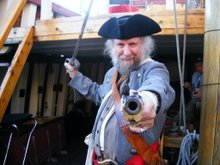
I was on my boat attacking the ship with a small swivel gun and hand-arms. We also had a couple of people on the jetty and defenders firing from the quarter deck.
After the ship closed on Saturday there was a lot of posing for pictures. Most pirates reenactors don't get to take over a ship long enough to do extended photo ops.
Around 15 people spent the night on the ship. There were some complaints about how hard the deck is to sleep on and how cold it was (the low was in the upper 40s). One thing I like about pirate events is that people sleep late. Usually I'm one of the last up at reenactments but I am usually one of the first at pirate events.
Sunday's battle was slightly scaled down. Several people could only be there for Saturday and we were out of powder for my swivel gun. We still managed a credible battle.
People started packing in earnest after the battle and were pretty much gone by 4:00. This was a shame since the ship still had visitors but it is a fact of life for reenactments where people come from out of town.
Monday, May 11, 2009
Getting the Whitehall in the Water
In the last few weeks I managed to finish sanding and painting the Whitehall and get it ready to put in the water. I spent the last two weeks before launching it pouring water into it to swell the planks. I saw this recommended as a way of avoiding the "Oh my God, my boat's sinking!" feeling when a wood planked boat is put in the water after a long haul-out. I'm glad I did this. When I first started soaking the hull, water poured out. Later it still dribbled out.
We got it in the water down a nasty boat ramp. The car got stuck in some wet mud (silt) and we had to get some help to get it loose. While we waited for a tow chain, I rowed the Whitehall around a bit. It handled fine.
The occasion was a pirate event at the Santa Maria which is 1/2 mile from the boat launch. After we got the car free, I set off with a volunteer crew. I didn't have the rudder on yet so we steered with the oars and a paddle that I used from the bow. The boat took a on a bit of water but not too much.
I checked it regularly. By nightfall it had stopped taking in water. It still leaks when people are in it. The extra weight forces the boat lower in the water and water seeps in past planks that have not swollen shut yet. If I could just have three or four people sit in the boat for 6-8 hours then this leak would swell shut, also.
We used it for the battle both days. We had three people the first day and four the second. Michael and I also went out with the wives. The boat is fine with four people - not crowded at all. We could fit in a fifth person. Any more than that would be crowded.
It rows well. It has three rowing stations but only two sets of oars. I decided that this is so that one person can row from the middle station (the sliding rowing seat and the foot pedals for the tiller are both set up for here. If you have two people rowing then it is better to have them in the first and third rowing stations. That way the oars don't have to be in perfect unison.
The swivel gun mount I rigged up on the bow worked perfectly. The small gun I have is quite loud, especially with a double charge.
We had three people on the way back to the boat ramp - two rowing and one at the tiller. I could tell the difference when I was rowing by myself but it wasn't a lot harder. A half-hour row upstream wasn't enough to make me breath hard. My hands where the main thing that got tired although I could feel it later.
We did have some trouble with the oars and the oarlocks, especially with the "sweeps" - the traditionally shaped oars. I used those on the row to the boat ramp and the collars that are supposed to keep the oar from going too far up the oarlock are too small. I need to do something to make these bigger.
Other that that, everything worked fine. Now I want to try sailing it but that will have to wait a couple of weeks.
We got it in the water down a nasty boat ramp. The car got stuck in some wet mud (silt) and we had to get some help to get it loose. While we waited for a tow chain, I rowed the Whitehall around a bit. It handled fine.
The occasion was a pirate event at the Santa Maria which is 1/2 mile from the boat launch. After we got the car free, I set off with a volunteer crew. I didn't have the rudder on yet so we steered with the oars and a paddle that I used from the bow. The boat took a on a bit of water but not too much.
I checked it regularly. By nightfall it had stopped taking in water. It still leaks when people are in it. The extra weight forces the boat lower in the water and water seeps in past planks that have not swollen shut yet. If I could just have three or four people sit in the boat for 6-8 hours then this leak would swell shut, also.
We used it for the battle both days. We had three people the first day and four the second. Michael and I also went out with the wives. The boat is fine with four people - not crowded at all. We could fit in a fifth person. Any more than that would be crowded.
It rows well. It has three rowing stations but only two sets of oars. I decided that this is so that one person can row from the middle station (the sliding rowing seat and the foot pedals for the tiller are both set up for here. If you have two people rowing then it is better to have them in the first and third rowing stations. That way the oars don't have to be in perfect unison.
The swivel gun mount I rigged up on the bow worked perfectly. The small gun I have is quite loud, especially with a double charge.
We had three people on the way back to the boat ramp - two rowing and one at the tiller. I could tell the difference when I was rowing by myself but it wasn't a lot harder. A half-hour row upstream wasn't enough to make me breath hard. My hands where the main thing that got tired although I could feel it later.
We did have some trouble with the oars and the oarlocks, especially with the "sweeps" - the traditionally shaped oars. I used those on the row to the boat ramp and the collars that are supposed to keep the oar from going too far up the oarlock are too small. I need to do something to make these bigger.
Other that that, everything worked fine. Now I want to try sailing it but that will have to wait a couple of weeks.
Tuesday, May 5, 2009
Pet Peeves
There are a lot of things that show up at historic festivals that shouldn't. Many of these have jumped from celtic and Renaissance festivals.
Bodhrons - Those flat drums that are played on-handed. I don't object to them as instruments. I know several talented bodhron players. Unfortunately, none of them come to historic events. The people who pull these out at historic events seldom have any idea how to play them properly. You are supposed to press your left hand against the skin from the back, changing the tone as you play. You hold the beater like a pencil and only use one end with a sort of brushing motion. When played properly, it is a rather soft instrument and one of the few drums that isn't a monotone.
Even if played correctly, these instruments are inappropriate. Some people trace them back hundreds of years. Others say that they were an agricultural tool that was occasionally used for rhythm in very poor, agricultural areas of Ireland and not a part of mainstream Irish music until the 1970s. Either way, they were obscure before the late 20th century.
Utilikilts - A proper kilt is a long piece of wool, folded into pleats and belted into a garment. Later (we're talking Victorian period) the pleats were sewn into the kilt to make it easier to put on. In the 1990s, some Americans started making kilts out of heavy cotton with wide pleats sewn in and snap closures. These are fine for celtic fesitvals but out of place at historic events. I have one but I am selective where I wear it.
Irish Music - It used to be that you heard lots of old folk music at historic events. These days it is pretty much limited to 19th and 20th century Irish music. Don't get me wrong - I love Irish music and play in Irish sessions a few times a month, but most of it is out of period for anything earlier than the Civil War.
Bodhrons - Those flat drums that are played on-handed. I don't object to them as instruments. I know several talented bodhron players. Unfortunately, none of them come to historic events. The people who pull these out at historic events seldom have any idea how to play them properly. You are supposed to press your left hand against the skin from the back, changing the tone as you play. You hold the beater like a pencil and only use one end with a sort of brushing motion. When played properly, it is a rather soft instrument and one of the few drums that isn't a monotone.
Even if played correctly, these instruments are inappropriate. Some people trace them back hundreds of years. Others say that they were an agricultural tool that was occasionally used for rhythm in very poor, agricultural areas of Ireland and not a part of mainstream Irish music until the 1970s. Either way, they were obscure before the late 20th century.
Utilikilts - A proper kilt is a long piece of wool, folded into pleats and belted into a garment. Later (we're talking Victorian period) the pleats were sewn into the kilt to make it easier to put on. In the 1990s, some Americans started making kilts out of heavy cotton with wide pleats sewn in and snap closures. These are fine for celtic fesitvals but out of place at historic events. I have one but I am selective where I wear it.
Irish Music - It used to be that you heard lots of old folk music at historic events. These days it is pretty much limited to 19th and 20th century Irish music. Don't get me wrong - I love Irish music and play in Irish sessions a few times a month, but most of it is out of period for anything earlier than the Civil War.
Wednesday, April 29, 2009
Deadliest Warrior - Pirate vs Knight
Some thoughts on Spike TV's Deadliest Warrior series Pirate vs Knight episode.
Before it started my opinion was that if the pirate didn't win then there was either something wrong with the show's format or with history. The knight wore armor and was armed with a crossbow and hand weapons. The pirate didn't wear armor but had three gunpowder-based weapons (blunderbuss, pistol, and grenado).
The results were what I expected. The pirate's pistol could not penetrate the knight's armor but his blunderbuss and grenado could. Armor at the time was tested by shooting it with a pistol. If it couldn't stop a pistol ball then it was sent back to be strengthened. I was impressed that the blunderbuss and grenado penetrated the armor.
The knight's hand weapons were equal to or better than the pirate's. The knight was fighting other people in armor so he needed extra cutting power. The pirate didn't have to deal with armored enemies so his hand weapons could not pierce armor.
The introduction of the heavy musket in the early 17th century made armor obsolete. For a while, armies tried making the armor thicker and eliminating lower leg pieces in order to lighten it but this was impractical. By the mid-17th century armies had pretty much given up on armor.
So, by the late 17th century, pirates did not wear armor but they carried the weapons that had made armor obsolete.
But what about ninjas? Last week they had a ninja face off against a Greek warrior. The warrior's armor and shield gave him the advantage against the ninja. Based on the weapons that the pirate and ninja used, the pirate would still win. His blunderbuss, grenado, and pistol were all either deadlier or had longer range than the ninja weapons. The ninja might have a small advantage in close-in fighting but it would be small.
Before it started my opinion was that if the pirate didn't win then there was either something wrong with the show's format or with history. The knight wore armor and was armed with a crossbow and hand weapons. The pirate didn't wear armor but had three gunpowder-based weapons (blunderbuss, pistol, and grenado).
The results were what I expected. The pirate's pistol could not penetrate the knight's armor but his blunderbuss and grenado could. Armor at the time was tested by shooting it with a pistol. If it couldn't stop a pistol ball then it was sent back to be strengthened. I was impressed that the blunderbuss and grenado penetrated the armor.
The knight's hand weapons were equal to or better than the pirate's. The knight was fighting other people in armor so he needed extra cutting power. The pirate didn't have to deal with armored enemies so his hand weapons could not pierce armor.
The introduction of the heavy musket in the early 17th century made armor obsolete. For a while, armies tried making the armor thicker and eliminating lower leg pieces in order to lighten it but this was impractical. By the mid-17th century armies had pretty much given up on armor.
So, by the late 17th century, pirates did not wear armor but they carried the weapons that had made armor obsolete.
But what about ninjas? Last week they had a ninja face off against a Greek warrior. The warrior's armor and shield gave him the advantage against the ninja. Based on the weapons that the pirate and ninja used, the pirate would still win. His blunderbuss, grenado, and pistol were all either deadlier or had longer range than the ninja weapons. The ninja might have a small advantage in close-in fighting but it would be small.
Monday, April 13, 2009
Whitehall Progress
I'm making progress on getting the boat ready for sailing. While the boat is in good condition, there were still a lot of steps:
The boat came with 1/4" line for rigging. This was too big for many of the gromets and the cleats. I repalced it with 3/16". This seems to be the right size.
I think that I have all of the thumb cleats figured out. I'm still wondering about a pair of blocks and cleats. They seem to be placed for the jib but there are also a pair of thimbles on the side that are more typical for the jib.
I have one piece of line with an attached bronze block left over. Possibly it is for dowsing the sail by raising the boom up to the mast. I will have to experiment with that.
I still have to get the boat turned around so that I can hoist it off of the trailer so that I can get the trailer weighed. Then I have to get the trailer licensed so that I can take the boat to the DNR to get a hull number so that I can get it licensed. I'd like to have it painted before going to the DNR but that depends on the weather.
- I had to put a tongue hinge on the trailer so that I could get it further into the garage, under the stronger joists.
- Once there, I hung two chain hoists from the ceiling.
- With those, I could properly sand the bottom.
- I started with the centerboard. The part that I could see when it was on the trailer looked pretty corroded. It turned out that this was the worst part. Since the leading edge is always in the water when the centerboard is pulled back, that is the part that looked the worst. It was mainly paint bubbling off with some minor surface rust. I sanded this down to bare metal as much as I could. I primed it with a Rustolium for rusty surfaces. This is supposed to be stickier and should take care of any place I missed when sanding. I used two coats then put two coats of finish paint on.
The boat came with 1/4" line for rigging. This was too big for many of the gromets and the cleats. I repalced it with 3/16". This seems to be the right size.
I think that I have all of the thumb cleats figured out. I'm still wondering about a pair of blocks and cleats. They seem to be placed for the jib but there are also a pair of thimbles on the side that are more typical for the jib.
I have one piece of line with an attached bronze block left over. Possibly it is for dowsing the sail by raising the boom up to the mast. I will have to experiment with that.
I still have to get the boat turned around so that I can hoist it off of the trailer so that I can get the trailer weighed. Then I have to get the trailer licensed so that I can take the boat to the DNR to get a hull number so that I can get it licensed. I'd like to have it painted before going to the DNR but that depends on the weather.
Friday, April 10, 2009
Pirates vs Ninjas
I was watching an episode on Ultimate Warrior on Spike TV and got inspired.
Ultimate Warrior is one of several shows that tries to use computer simulations to answer questions about who would win unlikely fights. Other variations have matched animals (lion vs tiger) and dinosaurs. This one takes different warriors, evaluates them, and predicts most likely winners. The episode that I watched matched a Roman gladiator against an Apache warrior. The Apache won.
So, pirate vs ninja - who would win?
This really depends on how you define the match up. Each has very different strengths and weaknesses.
In straight, hand-to-hand fighting between individuals, the ninja would win. Pirates were self-taught fighters. Ninjas were trained assassins. Also, the main time the two fought would probably be at a time and place of the ninja's choosing (probably at night when the pirate was drunk) giving him an advantage.
On the other hand, put them 100 yards apart in broad daylight with a sober pirate and things change. Many pirates started out as buccaneers, hunting wild cattle. They were very good shots. A pirate could get off a couple of well-aimed shots at a ninja before the ninja could get within reach. There are things that the ninja could do to avoid being shot but they would slow him down, giving the pirate time for more shots. A ninja with a bow would have a chance but arrows are not as disabling as gunshot wounds.
What about a ship full of pirates vs a ship full of ninjas. Again, the pirates have the advantage. European ships and cannons were the best in the world. Pirates boarding a ship full of ninjas would still have an advantage. Ninjas had a variety of weapons but few of them worked against a large organized force. Those that did were as likely to hinder the ninjas as pirates. The weapons favored by pirates worked well against a massed enemy in cramped spaces. The two-handed sword that ninjas used needed space to swing or you would hit a comrade. Cutlasses were short and heavy to overcome that problem. The ninjas would still be better trained but a pistol or blunderbuss goes a log way in nullifying that advantage. That's after a swivel gun or two decimated the ninjas before the pirates boarded.
Just to be fair, there is also the possibility of a group of ninjas boarding a ship at night. The ninjas would have the advantage here since the pirates would be disorganized and probably drunk.
In general, though, cultures with guns tended to triumph over cultures with hand weapons.
Ultimate Warrior is one of several shows that tries to use computer simulations to answer questions about who would win unlikely fights. Other variations have matched animals (lion vs tiger) and dinosaurs. This one takes different warriors, evaluates them, and predicts most likely winners. The episode that I watched matched a Roman gladiator against an Apache warrior. The Apache won.
So, pirate vs ninja - who would win?
This really depends on how you define the match up. Each has very different strengths and weaknesses.
In straight, hand-to-hand fighting between individuals, the ninja would win. Pirates were self-taught fighters. Ninjas were trained assassins. Also, the main time the two fought would probably be at a time and place of the ninja's choosing (probably at night when the pirate was drunk) giving him an advantage.
On the other hand, put them 100 yards apart in broad daylight with a sober pirate and things change. Many pirates started out as buccaneers, hunting wild cattle. They were very good shots. A pirate could get off a couple of well-aimed shots at a ninja before the ninja could get within reach. There are things that the ninja could do to avoid being shot but they would slow him down, giving the pirate time for more shots. A ninja with a bow would have a chance but arrows are not as disabling as gunshot wounds.
What about a ship full of pirates vs a ship full of ninjas. Again, the pirates have the advantage. European ships and cannons were the best in the world. Pirates boarding a ship full of ninjas would still have an advantage. Ninjas had a variety of weapons but few of them worked against a large organized force. Those that did were as likely to hinder the ninjas as pirates. The weapons favored by pirates worked well against a massed enemy in cramped spaces. The two-handed sword that ninjas used needed space to swing or you would hit a comrade. Cutlasses were short and heavy to overcome that problem. The ninjas would still be better trained but a pistol or blunderbuss goes a log way in nullifying that advantage. That's after a swivel gun or two decimated the ninjas before the pirates boarded.
Just to be fair, there is also the possibility of a group of ninjas boarding a ship at night. The ninjas would have the advantage here since the pirates would be disorganized and probably drunk.
In general, though, cultures with guns tended to triumph over cultures with hand weapons.
Subscribe to:
Posts (Atom)