Officially this is a biography of the twice-governor of the Bahamas and the man who ended piracy in the Caribbean. While Woodes Rogers had an eventful life, details of it are sketchy so the book is padded with a lot of general information on piracy. It also contains a mini-biography of Alexander Selkirk who was an inspiration for Robinson Crusoe.
The book was written by David Cordingly who has written other major works on piracy such as Under the Black Flag and his familiarity with piracy shows.
While Rogers was twice governor of the Bahamas, this was not his major achievement. He was one of the first captains to circumnavigate the world and his exploits doing this and attacking the Spanish in the Pacific are more exciting than a Pirates of the Caribbean novel.
In addition to Rogers and Selkirk, the book follows other pirates to their end including Blackbeard and Calico Jack Rackham. Several battles are described in detail showing just how audacious the pirates and privateers were.
Wednesday, September 28, 2011

Monday, September 19, 2011
Talking Like a Pirate on the Santa Maria
We held our annual Talk Like a Pirate Weekend on the Santa Maria September 17 & 18. The event is held on the closest weekend to Talk Like a Pirate Day.
Gas prices, health problems, and competing festivals kept the number of pirates down but we still had a decent turn-out. Counting ship staff members who put on costumes, we had nearly twenty pirates.
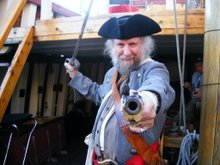
This is an educational event and the pirates worked hard. We had different stations where people were presenting something relating to pirates. This included Mission's pirate surgeon display, a gaming table, and cooking. I brought my new cannon and ran visitors through cannon drills. Michael made a hammock. There was also a table where kids could get certificates making them part of the pirate crew. These were hand-lettered and had wax seals.
We had to scale back the battle. Sometimes we have had enough pirates to fill three boats. This time we only used one boat with no effort to actually board the ship. I don't think that the visitors noticed the difference.
Attendance was not as good as last year but it was still a very good weekend taking in just under $2,000 for the weekend.
Disney contacted us and donated hundreds of posters and certificates for two Pirates of the Caribbean: On Stranger Tides DVD so every family got a posted and a chance to win a DVD.
Gas prices, health problems, and competing festivals kept the number of pirates down but we still had a decent turn-out. Counting ship staff members who put on costumes, we had nearly twenty pirates.
This is an educational event and the pirates worked hard. We had different stations where people were presenting something relating to pirates. This included Mission's pirate surgeon display, a gaming table, and cooking. I brought my new cannon and ran visitors through cannon drills. Michael made a hammock. There was also a table where kids could get certificates making them part of the pirate crew. These were hand-lettered and had wax seals.
We had to scale back the battle. Sometimes we have had enough pirates to fill three boats. This time we only used one boat with no effort to actually board the ship. I don't think that the visitors noticed the difference.
Attendance was not as good as last year but it was still a very good weekend taking in just under $2,000 for the weekend.
Disney contacted us and donated hundreds of posters and certificates for two Pirates of the Caribbean: On Stranger Tides DVD so every family got a posted and a chance to win a DVD.
Friday, September 9, 2011
Small Boats
I've been reading Pirate Hunter of the Caribbean: The Adventurous Life of Captain Woodes Rogers and I was struck by the use of small, open boats. In several cases pirates left their ships behind and attacked ships or even cities from boats.
Attacking cities always meant landing which usually meant using boats. It was common for pirates to land some distance from a city and attack it from land. But other times they would land and attack.
Fighting a ship from a boat seems foolish. One good hit from a cannon and the boat is gone. On the pirate's side, they could only carry small arms.
Surprisingly this was enough. In one case three dug-outs carrying sixty some pirates met three warships with over two hundred sailors and soldiers. The pirates won, driving off one ship and forcing the other two to surrender.
Boats offer a few advantages over ships. Boats were faster and could move against the wind. In the case above, the pirates shot the helmsman of one ship and it turned into the wind and stopped - what is known as being "in irons". They continued to shoot anyone who tried to take the tiller. Since cannons are mainly aimed by turning the ship, that rendered the cannon useless.
The pirates were better shots than the Spanish. After the battle ended, the Spanish tallied their dead and wounded. Only a half-dozen were completely unharmed.
I read a different account in in Exquemelin where he describes a small ship taking a much larger one. In this case the Spanish captain saw the pirates but dismissed them as being too inferior a force to threaten his ship. After dark the pirates used a boat to board the Spanish ship, took the captain hostage, and forced the surrender of the ship.
Attacking cities always meant landing which usually meant using boats. It was common for pirates to land some distance from a city and attack it from land. But other times they would land and attack.
Fighting a ship from a boat seems foolish. One good hit from a cannon and the boat is gone. On the pirate's side, they could only carry small arms.
Surprisingly this was enough. In one case three dug-outs carrying sixty some pirates met three warships with over two hundred sailors and soldiers. The pirates won, driving off one ship and forcing the other two to surrender.
Boats offer a few advantages over ships. Boats were faster and could move against the wind. In the case above, the pirates shot the helmsman of one ship and it turned into the wind and stopped - what is known as being "in irons". They continued to shoot anyone who tried to take the tiller. Since cannons are mainly aimed by turning the ship, that rendered the cannon useless.
The pirates were better shots than the Spanish. After the battle ended, the Spanish tallied their dead and wounded. Only a half-dozen were completely unharmed.
I read a different account in in Exquemelin where he describes a small ship taking a much larger one. In this case the Spanish captain saw the pirates but dismissed them as being too inferior a force to threaten his ship. After dark the pirates used a boat to board the Spanish ship, took the captain hostage, and forced the surrender of the ship.
Monday, August 15, 2011
Brigand's Grove
Right off the bat, this was a disappointing event. It replaced the Pirates of Paynetown which was a wonderful event. When the site fell through, the organizer substituted an event in what amounts to his front yard (actually a field across a highway and down a hill from the historic building that houses his business).
A lot of participants dropped out and the new site was missing Paynetown's best features: a large lake, an attack from boats, and showers. Also it was no longer a "pirate" event. The new focus was on pirates, brigands, and other law breakers.
So it was a much smaller event and the field was not shaded most of the day which baked us, especially on Saturday.
And it wasn't a pirate event. It was a generic 18th century event with a couple of displays on piracy.
Also, the John Work House turned out to be further away than it appeared on the map. The map didn't show the steep hill with a slippery path that had to be climbed to get to the house (plus another story to get to the tavern). This resulted in a split event. Some people spent most of their time in the house and some in the field. I don't think that there was any point when everyone was in one place.
So, what good can I say about the event?
I got to use my cannon. I ran full cannon crew through the drill a couple of times them we did it with powder. I finally used enough powder for a decent bang - twice the charge as in my swivel gun. I also ran some visitors through the drill.
The "battles" were unusual but fun. We never had more than a dozen people on the field and not all of them were armed but this fit the scenario.
The first "battle" was a skirmish at the tavern. A bunch of us complained about the prices and it escalated to shooting. The redcoats arrived and drove the rowdies off.
For the official field battle, some of us went to the British to register our complaints. Things quickly got out of hand. Someone (Micky) was arrested and beaten to death. Someone else (me) was arrested and shot. Talk about the violence inherent in the system.
We got our own back. On Sunday we raided the tavern and made off with some stuff. Later we returned and found the redcoat officer by himself so we shot him. Finally I proclaimed, "In the name of no one in particular, I claim this land as ours. God save us!"
A lot of participants dropped out and the new site was missing Paynetown's best features: a large lake, an attack from boats, and showers. Also it was no longer a "pirate" event. The new focus was on pirates, brigands, and other law breakers.
So it was a much smaller event and the field was not shaded most of the day which baked us, especially on Saturday.
And it wasn't a pirate event. It was a generic 18th century event with a couple of displays on piracy.
Also, the John Work House turned out to be further away than it appeared on the map. The map didn't show the steep hill with a slippery path that had to be climbed to get to the house (plus another story to get to the tavern). This resulted in a split event. Some people spent most of their time in the house and some in the field. I don't think that there was any point when everyone was in one place.
So, what good can I say about the event?
I got to use my cannon. I ran full cannon crew through the drill a couple of times them we did it with powder. I finally used enough powder for a decent bang - twice the charge as in my swivel gun. I also ran some visitors through the drill.
The "battles" were unusual but fun. We never had more than a dozen people on the field and not all of them were armed but this fit the scenario.
The first "battle" was a skirmish at the tavern. A bunch of us complained about the prices and it escalated to shooting. The redcoats arrived and drove the rowdies off.
For the official field battle, some of us went to the British to register our complaints. Things quickly got out of hand. Someone (Micky) was arrested and beaten to death. Someone else (me) was arrested and shot. Talk about the violence inherent in the system.
We got our own back. On Sunday we raided the tavern and made off with some stuff. Later we returned and found the redcoat officer by himself so we shot him. Finally I proclaimed, "In the name of no one in particular, I claim this land as ours. God save us!"
Thursday, July 28, 2011
New England Pirate Museum

The museum is a small-scale operation housed in a brick building with trompe l'oeil pirates climbing up the outside walls. Tours are given every half hour. They are conducted by a guide in a "pirate" costume consisting of a lace-up shirt, black pants, sash, and bandanna. The tours last 20-25 minutes. There is a small gift shop where tours start and end.
The museum is not bad for what it is. It is mainly a series of sets with manikins dressed to represent historic pirates. Some of the sets are ambitious. The biggest one has part of a ship, a tavern, a gallows, and other building fronts. The manikins run from hokey to horrifying but they are really launching points for the guides. The real tour consists of the guide telling about various New England pirates. Many of them were unsuccessful.
The focus on New England gives the museum a fresh feel. These are pirates with a local tie-in who are seldom discussed. Bellamy and the Whydah, Blackbeard, and Kidd all had New England connections and are also mentioned.
I didn't catch and outright errors, just a few over-simplifications so even hard-core historians should enjoy the tour.
Monday, July 11, 2011
Book Review - PotC: Price of Freedom
The Price of Freedom (Pirates of the Caribbean) by A. C. Crispin is a PotC tie-in telling Jack Sparrow's back-story. It was already known that the Black Pearl was originally known as the Wicked Wench but was sunk and burned. Jack made a deal with Davy Jones to raise it. We also know that Jack's father was the Keeper of the Code and that Jack was branded as a pirate after failing to deliver a load of slaves. This novel was written to fill in the details.
The plot mainly follows Jack as he goes from first mate on an East India Trading Company ship to captain of the Wicked Wench. There are a lot of flashbacks to Jack's earlier life on Shipwreck Island explaining how he came to leave it. Jack is working for Cutler Becket and we get his back-story as well. For good measure, there is a princess from a lost colony of Egypt who is searching for her lost father and brother.
The book has several familiar cameos. There is also a pirate princess and a group of rouge pirates who do not follow the code.
It isn't a bad book but it has one major flaw - the main character just doesn't feel like Jack Sparrow. He's too nice and totally trustworthy. He plans things out ahead of time.
As pirate books go, it isn't bad. The author did a lot of research although there are some anachronisms lie the use of a Blackwall Frigate which was designed in 1830. Several other details are better researched and it provides a nice explanation for some of Jack's appearance in the movies.
I suggest waiting for paperback.
The plot mainly follows Jack as he goes from first mate on an East India Trading Company ship to captain of the Wicked Wench. There are a lot of flashbacks to Jack's earlier life on Shipwreck Island explaining how he came to leave it. Jack is working for Cutler Becket and we get his back-story as well. For good measure, there is a princess from a lost colony of Egypt who is searching for her lost father and brother.
The book has several familiar cameos. There is also a pirate princess and a group of rouge pirates who do not follow the code.
It isn't a bad book but it has one major flaw - the main character just doesn't feel like Jack Sparrow. He's too nice and totally trustworthy. He plans things out ahead of time.
As pirate books go, it isn't bad. The author did a lot of research although there are some anachronisms lie the use of a Blackwall Frigate which was designed in 1830. Several other details are better researched and it provides a nice explanation for some of Jack's appearance in the movies.
I suggest waiting for paperback.
Thursday, June 30, 2011
Goodbye Paynetown
The Pirates of Paynetown event has been canceled due to differences between the site and the organizers. I am really sorry to see this event go. This event was what got us into pirate reenacting in the first place and it was always a favorite. It had several things to recommend it including:
- A large lake
- A fairly unique battle involving an attack on the camp by boats.
- A well-shaded camp site that had few anachronisms (as long as you didn't face north).
Subscribe to:
Posts (Atom)