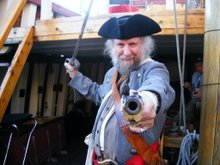
How should you dress if you want to represent a pirate? This is a conundrum. The contemporary pictures were not drawn by eyewitnesses. At best, they represent how a contemporary person interpreted the descriptions of others.
There are a few eyewitness accounts. From that, the average pirate dressed like an average sailor. That means either long pants or slops and a short jacket.
The problem is that, if you dress like an 18th century sailor, most people are not going to know that you are portraying a pirate.
There are some things that you can do to liven up an impression. Sailors in general and pirates specifically would have access to some exotic accessories and some affected an unusual appearance.
Gold earings and a silk skarf or bandanna can certainly be justified.
Captains dressed better than crewmen, often dressing like a navy officer. They were more likely to add extra touches. Blackbeard is the ultimate example with a long, bushy black beard that he tied up with ribbons.
Pirates fought more often than regular sailors, probably more often than seamen in the navy. They walked around heavily armed. There are several descriptions of pirates wearing a sash with a brace (pair) of pistols tucked in it. They often wore a sword on a baldric.
Pirates often went into battle with a badric holding up to six holstered pistols. This was important in hand-to-hand combat. It takes several seconds and both hands to load a pistol and you only get one shot (or none if the powder is wet). The only way to get multiple shots was to carry multiple pistols.
I'm not sure about justification for bucket topped boots. At sea, pirates tended to go barefoot to avoid slipping. On shore, at port, they might dress up.
The tricorn (a three-cornered hat) was pretty universal from the late 17th century through the early 19th century. It is not something that a pirate would wear at sea - it is too easily knocked off while climbing the rigging or simply blown off, but it is something else that a pirate might wear at port to dress up.
The parrot as an accessory comes from Treasure Island. Long John Silver kept one. They are common in the Caribbean and were in demand elsewhere. Some pirates were known to give parrots as gifts. There is no reason why a pirate could not pick up a parrot as a pet or something to be sold later.
Showing posts with label pirates. Show all posts
Showing posts with label pirates. Show all posts
Friday, June 29, 2007

Thursday, June 28, 2007
The Pirate's Dinghy
Too many pirates don't have a boat. We didn't want to be land-locked pirates. On the other hand, we didn't want anything too large to handle nor did we want to spend all of our booty on a boat.
I spent days searching ads before I ran across Walker Bay. This is not a traditional wood boat. It is cast plastic. Still, it has a lot of things in its favor:
 The sail kit that you can get for it does not look at all period and it more than doubles the price of the boat. I decided to make my own sail.
I started with a couple of old pike poles, and added a sail made from a canvas drop-cloth and some white duct tape. I used a sprit-rig which seems like the best choice because:
I added some wood-grain contact paper around the rail. It really improves the look of the dinghy.

Now I need to make a tiller and dagger-board and I'll be ready to sail.
I spent days searching ads before I ran across Walker Bay. This is not a traditional wood boat. It is cast plastic. Still, it has a lot of things in its favor:
- It's cheap.
- It is tough - no "hole in the water that you fill with money."
- The way it was cast it looks like a lapstrake wooden boat (one with over-lapping planks).
- It is light enough for me to move by myself.
- It is small enough and light enough to fit on the top of my van.
- It can take a sail.
 The sail kit that you can get for it does not look at all period and it more than doubles the price of the boat. I decided to make my own sail.
I started with a couple of old pike poles, and added a sail made from a canvas drop-cloth and some white duct tape. I used a sprit-rig which seems like the best choice because:
- It was in use for centuries
- It does not need standing rigging
- It does not have a boom so my wife will not get hit in the head when tacking.
- It is supposed to be beginner-friendly.
I added some wood-grain contact paper around the rail. It really improves the look of the dinghy.

Now I need to make a tiller and dagger-board and I'll be ready to sail.
So you want to be a pirate!
I've been reenacting in different periods for around 30 years but a lot of the events and sites that we used to go to have fallen through. So - my wife and I decided to try pirating. There are pirate events and we even know some of the people who go to them. Also, it gives me an excuse to get a sailboat which I've been wanting to do for years.
Getting a costume is easy. I've been doing a pirate with just the stuff from my closet for years. Recently I got a new coat, a nice, 1760-1770s gray wool frock coat with big buttons. It's nicely made and a good price.
Now, when doing a pirate impression there is the big question - should you go with what they actually looked like or what people expect? I'm compromising and calling myself a captain. They seem to have worn the longer coats. The regular seamen dressed like any other sailors with shorter coats that were easier when climbing the rigging.
The other thing I'm doing in having some sloops made. These were wide pants that end at the knee. They developed during the 17th century when most people wore full breeches that were gathered at the knee. I found out a couple of years ago that these hold water. The sloops are not gathered at the knee and are fairly light weight material so they can dry quickly.
I can use these with my other 17th century stuff so these should be generally useful.
Getting a costume is easy. I've been doing a pirate with just the stuff from my closet for years. Recently I got a new coat, a nice, 1760-1770s gray wool frock coat with big buttons. It's nicely made and a good price.
Now, when doing a pirate impression there is the big question - should you go with what they actually looked like or what people expect? I'm compromising and calling myself a captain. They seem to have worn the longer coats. The regular seamen dressed like any other sailors with shorter coats that were easier when climbing the rigging.
The other thing I'm doing in having some sloops made. These were wide pants that end at the knee. They developed during the 17th century when most people wore full breeches that were gathered at the knee. I found out a couple of years ago that these hold water. The sloops are not gathered at the knee and are fairly light weight material so they can dry quickly.
I can use these with my other 17th century stuff so these should be generally useful.
Subscribe to:
Posts (Atom)